
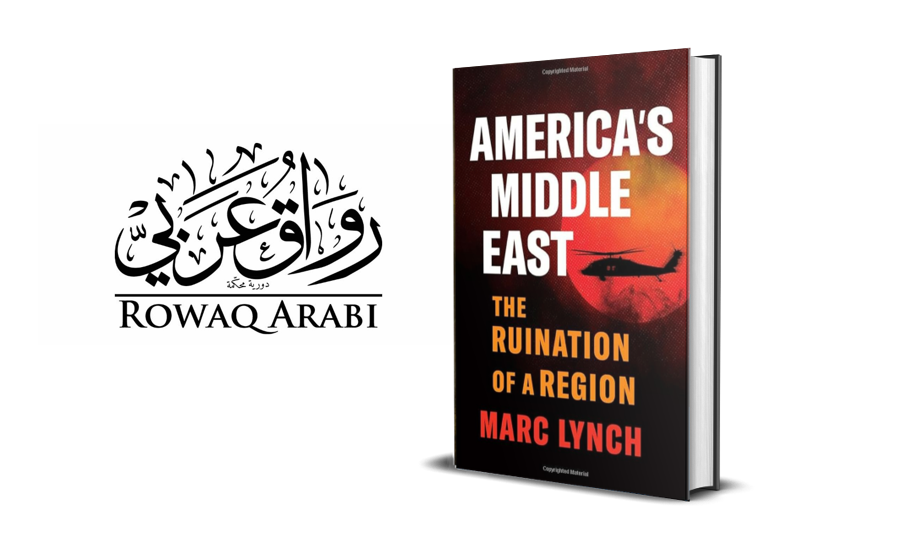
Citation: Hicks, Neil. 2026. “Book Review: ‘America’s Middle East, The Ruination of a Region’ by Marc Lynch,” Rowaq Arabi 31 (1): 41-44. https://doi.org/10.53833/LXYJ9067.
Title: America’s Middle East, The Ruination of a Region
Author: Marc Lynch
Publisher: Hurst & Company
Year of Publication: 2025
Hardback ISBN: 9781805264019
Marc Lynch’s searing critique of US foreign policy towards the Middle East over the past three decades is clarifying. It is born out of rage at America’s complicity in Israel’s genocidal reprisal on the Gaza Strip after the Hamas attack on Israel of 7 October 2023, as he makes plain in the prologue, and the willingness of the Democratic administration of Joe Biden (elected on the promise of righting the wrongs of the first Trump administration) to enable these crimes.
The mass slaughter in Gaza is not exceptional in the ‘powerfully institutionalized structure’[1] of America’s ‘astonishingly inhumane policies’ across the Middle East, imposed for decades with remarkable consistency. An outraged Lynch identifies the ‘core problem’ as America being unwilling ‘to accept that people in the region are human beings.’ That is to say that during this period leading up to the present, US policy has been based on the systematic denial of human rights for the vast majority of the people living in the region.
The ruinous structure Lynch describes is the 35-year period of American regional primacy after the end of the Cold War. While the Cold War period was hardly a time when the United States was standing up for human rights in the Middle East, or across much of the Global South, there was a global framework of a struggle between Western democracies, led by the United States against the Soviet Union and Communist China, in the name of democracy and freedom. Within that framework, human rights for the Middle East were sacrificed in the name of the priority given to the global fight against authoritarian communism, with the assumed prospect of human rights and democracy eventually. Even then, Lynch suggests, ‘bi-polarity imposed restraint’ on US policy options since local leaders could play off each great power against the other.
With US primacy, after 1990, the persistent failure to act in accordance with the human rights norms Washington professed so vociferously was laid bare. Policies invariably supported authoritarianism over democracy and military spending over development support. Friendly autocrats were protected from accountability for the violations imposed on their populations. Regional autocrats received this protection for advancing US policy priorities: protecting Israel; ensuring the flow of oil and gas, and pushing back against influence from rival powers like Russia or China. Iran, the leading regional opponent to American regional primacy, was to be contained and restrained.
Lynch correctly observes that sustaining this system that required the absence of democracy and disregarded the well-being of the great majority of people in the region became the conventional wisdom in Washington and beyond. US policy makers congratulated themselves on providing public goods like access to secure energy resources and regional order, but Lynch suggests it was ‘a veneer of order.’
Gaza has been a clarifying moment. Israel’s America-abetted genocide brings to his mind Gramsci’s maxim that power is at its weakest when it has to be deployed in the open. He sees it as a sign of America’s dwindling hegemony over the region. There are no human rights and no rules-based international order in Lynch’s America’s Middle East system. Gaza greatly accelerated unease with US policies towards the Middle East among Americans and around the world. This trend has only been accelerated further by Israel and America’s illegal attack on Iran in February 2026, after this book’s publication, further strengthening Lynch’s case that, pace Gramsci, America’s regional hegemony may be coming to an end.
Lynch welcomes this development. He quotes approvingly Noura Erakat’s observation: ‘There is no clear dividing line between a colonial power’s imperial geography and its metropole,’[2] in a discussion of the crushing of protests against Israel’s Gaza genocide on American college campuses. The salience of this observation is further illustrated by the threats from the current Trump administration to remove broadcast licenses from national news networks for any critical coverage of the war against Iran. Another of Erekat’s phrases: ‘the boomerang comes back’[3] would seem applicable.
Lynch notes that America’s system increasingly ‘runs afoul of world opinion, international law and the evidence of one’s own eyes.’[4] He is not especially optimistic about what would come after the decline or withdrawal of American power in the region. He muses that Iran would probably be able to develop its own nuclear weapon capabilities, which would likely be followed by similar steps from Saudi Arabia and other regional states. How this would be an improvement is not self-evident.
He does put forward ‘the equal application of human rights and international law’[5] as another possible way forward. He dryly notes that, ‘It is difficult to push democratic change when your regional order depends on dictators.’[6] This obstacle would be removed in a more human rights – compliant system, but Lynch’s goal is not to make the case for human rights implementation as a remedy for the chronic instability and persistent human catastrophes of today’s Middle East. Rather, it is a mea culpa from a self-confessed player, albeit an admirably critical and clear-sighted one, in the US Middle East policymaking process.
The arguments he makes are familiar to a small coterie of US-based academics, think tank analysts, journalists, and NGO activists who have for decades been trying to highlight the failings and legal and moral costs of US Middle East policy while making little impact on policy as it has been practiced. Lynch lays out the policy failures of each administration from George H.W. Bush to Biden in some detail to support the case. What Lynch has detected, and what probably motivates his book, is that something has changed, or is changing. For many years the usual response from policymakers from both parties to arguments for an end to uncritical support for regional dictators was polite agreement followed by no action. This started to shift during the George W. Bush administration’s invasion of Iraq and broader ‘global war on terrorism’ when administration officials and their supporters would object strenuously to accusations from the coterie described above that US policies in Iraq, Afghanistan, Guantanamo Bay and beyond, amounted to war crimes, grave violations of human rights or even crimes against humanity. Normal service was resumed under the Obama administration with emollient words and little action only for a return to adversarial denial of well-documented violations facilitated by US policy under the first Trump administration.
Biden’s refusal to acknowledge and stop Israel’s genocide in Gaza, his ‘outrage’ that the International Criminal Court (ICC) might seek to hold Israeli leaders accountable for their alleged crimes, has been followed by frank statements from Trump and members of his second administration that they do not care about human rights or international law. They make no pretence that they are acting to uphold any kind of rules-based international order or upholding any public goods; they are seeking to advance US interests through the exercise of power, primarily their superiority in conventional military force. This is a different world. It is a more honest presentation of the actual impacts of US policies, but whether it will result in different outcomes for the region remains a worryingly open question.
Lynch makes a not very convincing effort to suggest that his book is centred on the concerns of people in the region. He points out rightly that the United States exercises its outsized influence over the region through its allies: Israel, Saudi Arabia, the United Arab Emirates, Qatar, Egypt and Turkey acting as ‘primary drivers of regional stability.’[7] He says very little here about how these key relationships, with vastly differing dynamics in each one, could change in light of the dwindling of America’s regional hegemony, possibly with scenarios that might include better human rights outcomes that could improve the lives of millions.
Lynch has rightly sounded the alarm that the American led ‘ruination of the region’ has gone way past danger levels and needs to be brought to an end, either by political forces within the United States or by countervailing regional and international pressures, or some combination of both. How that might be achieved while avoiding evident attendant pitfalls and even deeper crises is a subject for further analysis and action hopefully beyond the small coterie already preoccupied by Lynch’s urgent concerns.
AI Assistance Statement
The author did not use any AI tools.
[2] Noura Erekat, “Election Chronicles: ‘The Boomerang Comes Back,’” The Boston Review, 2025, accessed 24 March 2026, https://www.bostonreview.net/articles/the-boomerang-comes-back/.
[3] Ibid.
[4] Lynch, America’s Middle East, 234.
[5] Ibid, 248.
[6] Ibid, 247.
[7] Ibid, 249.
Read this post in: