
Book Review: ‘From Apartheid to Democracy’ by Leah Whitson and Schaeffer Omer-Man
Citation: Khalifa, Ferial. 2026. “Book Review: ‘From Apartheid to Democracy’ by Leah Whitson and Schaeffer Omer-Man,” Rowaq Arabi 31 (2): 5-8. https://doi.org/10.53833/JRUG4253.
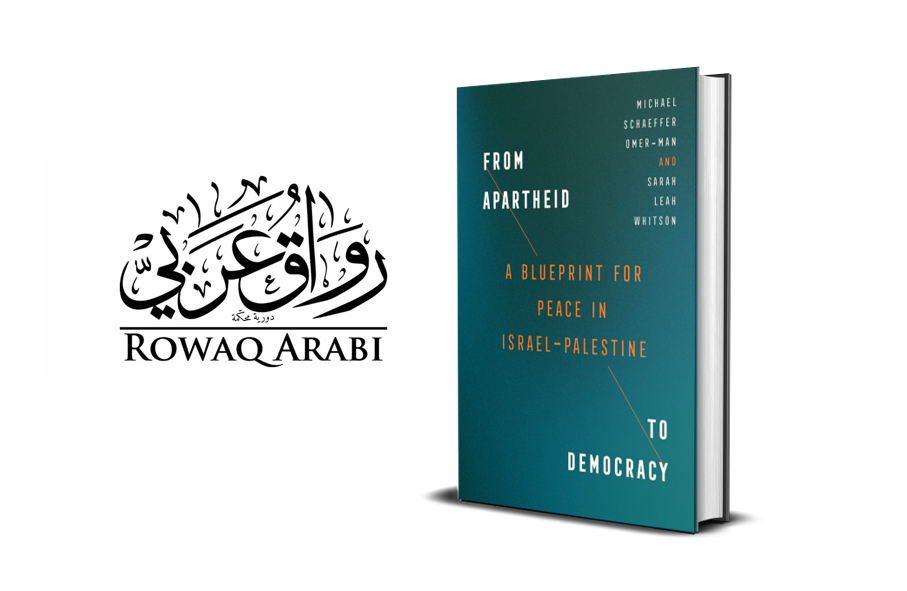
Title: From Apartheid to Democracy: A Blueprint for Peace in Israeli-Palestine
Authors: Sarah Leah Whitson and Michael Schaeffer Omer-Man
Publisher: University of California Press
Publication Year: 2025
Edition: 1
E-Book ISBN: 978-0-520-40201-0
Although similar to other works that reject separation and its two-state solution to resolve the Israeli-Palestinian conflict,[1] From Apartheid to Democracy: A Blueprint for Peace in Israel-Palestine moves beyond these works by providing a plan or ‘blueprint’ to transform what the authors describe as ‘an undemocratic, de facto one-state’[2] that currently prevails between the Jordan River and the Mediterranean Sea (referred to in the book as ‘the Territory’).[3] The rationale of the book is that while there are ‘mountains of reports’ that document Israeli abuses of Palestinians’ rights in the Occupied Palestinian Territory (OPT), there is a ‘dearth of ideas’ on how to ‘break that endless cycle’.[4]
The rationale is also to ‘move beyond’ the Oslo Accords framework and its (failed) two-state solution by reversing the negotiation sequence.[5] Instead of negotiating Palestinian self-determination, governance, and statehood, while the Israeli occupation and apartheid are still in place, the authors demand that these first end. The purpose of the blueprint is to guide the ‘strategic thinking’ of the global community, including the United States, and to ‘empower activists’ by providing them ‘a language to imagine’ a vision, policies and plans to transform that de-facto undemocratic apartheid-reality.[6]
Thus, the book’s audience are policymakers, think tanks, and decision-makers in the global community, as well as activists, both local and international; whose perspectives and contributions were essential in the book’s methodology. Through face-to-face and distant interviews, deliberations and conversations with one hundred stakeholders, the authors created the transformation plan, or the blueprint, which the book proposes.
Although the book embraces a ‘rights-respecting’ approach to this transformation, it claims that it does not prioritise individual rights over ‘structural’ changes.[7] What confirms this claim are the key structural changes that are proposed in Part 2, Sections 1-9. If applied, these changes will dismantle the building blocks of the apartheid regime, whether political, military, administrative, legal, ideological, or even symbolic – as discussed next.
Section 1 calls for the establishment of a three-year transitional Caretaker Government (CG) to replace both the Israeli state and the Palestinian Authority (PA). The CG would ‘oversee’ and ‘guide’ the transition from an apartheid regime to a democratic, rights-respecting one through a number of bodies (e.g. Transitional Justice and Domestic Security Committees, and Military Oversight and Free Movement Commissions).[8] The CG would organise national elections at the end of the transition and would meanwhile prepare ‘the ground’ for a referendum on the type of state/s the peoples of the Territory would like to establish in their shared territory.
Sections 2 and 4 discuss the measures needed to dismantle the population management tools, including military rule and restrictions on freedom of movement, that sustain the apartheid in the Territory. In the first week of the transition, the blueprint demands that the CG revoke Israeli military rule, replacing it with ‘a single civilian legal system’, followed by ending military courts and placing military prisons under civilian authorities’.[9] To institutionally backup this revocation, section 4 demands the suspension of the Israeli High Court of Justice, its replacement with a new High Court for the Transition, and the creation of a unified criminal court system across the Territory.
Section 3 demands that arrangement for the removal of the separation wall begin in the sixth month of the first year of the transition. The book argues that Israel’s movement restriction infrastructure —permits, checkpoints, and later the separation wall — has for long violated Palestinians’ rights to travel, reside, work, and cohabitation. It has also been a tool of demographic engineering to prevent the return of Palestinian refugees and enable Israel’s appropriation of Palestinian land and resources.[10] The new movement system would guarantee all Palestinians and Israelis the right to live, reside, work, and travel freely across all the Territory. Hence, civilian police, rather than the military, must enforce security measures at checkpoints, with the possibility of including international observers.
Section 5 addresses the legal foundation of Israel’s discriminatory regime. It demands that in week 9 of the transition, the CG retract racist, discriminatory laws. Examples include, among others, the Absentee Property Law, issued in 1950 to seize property owned by Palestinians expelled during the 1948 war, and the Law of Return (1950) ‘one of the most discriminatory’ Israeli laws, the book argues, because it offers ‘any Jew from any country’ the right to migrate and become a naturalised Israeli citizen, granting ‘non-native Jews immigration rights to the Territory’, while excluding exiled Palestinians from that right.[11] Another example is the Basic Law: Jerusalem, Capital of Israel (1980), which is considered by the authors to be illegal because it makes ‘a direct violation of the international legal prohibition on the acquisition of territory by force’.
Sections 6 and 9 address citizenship and voting rights and national elections. Section 6 explains that after integrating the population registry, the CG would extend full citizenship and voting rights to all adults in the new registry. The culmination of the blueprint, as discussed in Section 9, is a referendum on the type of state(s) the peoples of the Territory would wish to establish thereafter—whether two states, a confederation, or a federation.[12]
In Section 7, the CG would be required to create ‘a new and inclusive security doctrine’ to guide the creation and the training of ‘unified domestic security forces’ to replace the existing Israeli Security Agency (Shin Bet) and the Palestinian Preventive Security Forces.[13] The new security forces – now with a new name, the Domestic Intelligence Agency – would safeguard equal security for all peoples in the Territory, not only during the transition but also thereafter.[14]
In Section 8, the authors argue that a full transitional justice programme that would address reparations for Palestinians – such as property restitution, compensation for damages, and the realisation of refugee rights – should be postponed to a post-transition government, when it would be decided through a democratic decision-making process.[15] Other issues concerning Palestinian prisoners are nevertheless addressed, including requirements that in weeks 6 and 16 of the transition the Justice Ministry begin the release of administrative and political prisoners.[16] Furthermore, compensation for Palestinian victims of the occupation should occur within an international legal framework but local actors should plan and guide these plans to ensure that they address ‘the needs and desires of victims’ and to create ‘local ownership’[17] of the transition. The transformation must also include current Israeli state symbols, since they are ‘exclusionary to non-Jewish citizens’ living in the Territory, representing only the Jewish population. These include the name of the state itself, the Star of David flag, the national anthem, and the state seal of the menorah.[18]
What may seem an unrealistic proposal is addressed early in the book’s introduction and its second chapter, When Will the Blueprint Be Relevant?’ The blueprint’s application requires ‘ripeness’ and ‘buy-in’; the former of which would occur when both Israelis and Palestinians experience ‘dramatic shifts’ in their strategic outlooks due to their realisation of the high cost and suffering the conflict inflicts upon them.[19] ‘Buy-in’ would occur when major policymakers among both Palestinians and Israelis—such as military forces and security personnel— would have ‘earnest political will’ to support the plan. [20] The book acknowledges that ‘there is almost none [of this] today’. [21]
In its introduction and FAQ, the book addresses crucial issues that the proposed blueprint does not immediately address, such as the question of Palestinian refugees’ return and whether Israelis must relinquish Zionism.[22] In response, it emphasises that the blueprint’s primary aim is to end Israeli occupation and its systemic discrimination in the Territory, after which all other matters should be resolved democratically by the peoples living there.
One of the book’s strengths is that instead of embarking on a lengthy definition of the key terms it used (e.g. apartheid, transition, discrimination, transitional justice, etc.), it makes a direct shortcut into a detailed transformation plan. The book’s most salient strength, additionally, is that it breaks with the endless loop of a repressive apartheid reality not by merely describing and ethically criticising it, but by opening the conversation about how to change it, envisioning a radical alternative and practical plans for a transformation that is urgent indeed.
AI Assistance Statement
The author used ChatGPT to proofread the book review prior to Rowaq’s updated AI policy. The analysis, argument and structure of the review are entirely the author’s.
[1] Ghada Karmi, One State: The Only Democratic Future for Palestine–Israel (Pluto Press, 2023), https://doi.org/10.2307/jj.2036749; Leila H. Farsakh, “Alternatives to Partition in Palestine: Rearticulating the State-Nation Nexus,” in Rethinking Statehood in Palestine: Self-Determination and Decolonization Beyond Partition, ed. Leila H. Farsakh (University of California Press, 2021), 173-192, https://www.jstor.org/stable/j.ctv2rb768k.13.
[2] Sarah Leah Whitson and Michael Schaeffer Omer-Man, From Apartheid to Democracy: A Blueprint for Peace in Israeli-Palestine (University of California Press, 2025), 19.
[3] Leah Whitson and Omer-Man, From Apartheid to Democracy, 12.
[4] Ibid., 19.
[5] Ibid., 15.
[6] Ibid., 39.
[7] Ibid., 29.
[8] Ibid., 102.
[9] Ibid., 135.
[10] Ibid., 156.
[11] Ibid., 274.
[12] Ibid., 95-97.
[13] Ibid., 108.
[14] Ibid.
[15] Ibid., 228.
[16] Ibid., 228-229.
[17] Ibid., 227.
[18] Ibid., 192.
[19] Ibid., 27.
[20] Ibid.
[21] Ibid.
[22] Ibid., 39-40.
Read this post in: