
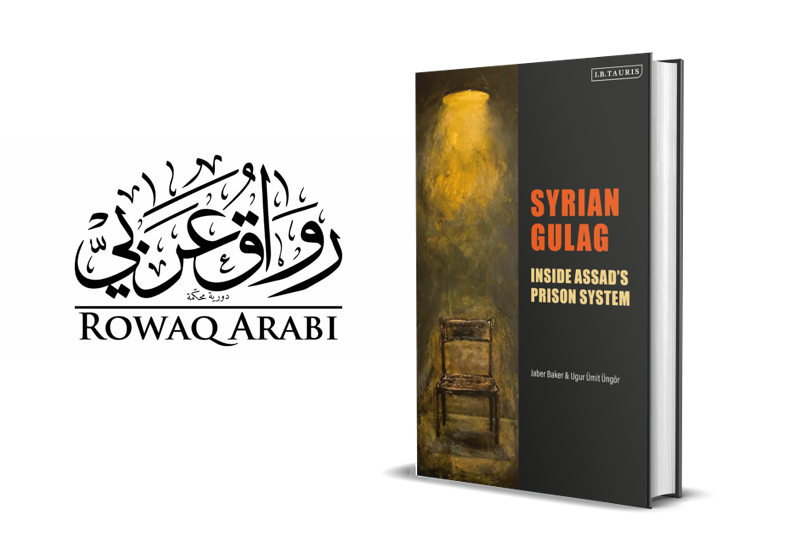
Citation: Aldardari, Sima. 2025. “Book Review: ‘Syrian Gulag’ by Jaber Baker and Uğur Ümit Üngör.” Rowaq Arabi 30 (3): 55-58. https://doi.org/10.53833/BZIC8701.
Title: Syrian Gulag: Inside Assad’s Prison System
Authors: Jaber Baker and Uğur Ümit Üngör
Publisher: Bloomsbury Publishing
Year of Publication: 2023
ISBN: 9780755650224
The Syrian Gulag is not an easy book to review. Not because it is poorly structured or written – quite the opposite – but because it documents the orchestrated violence that has haunted Syrians for the past five decades. Although this violence finally came to an end in December 2024, its effects continue to leave lasting scars on Syrian society.
The authors rely on the Soviet term ‘Gulag’ to describe the Syrian prison system because it serves the same function as the Gulag in quelling any form of opposition through ‘a vast canvas of camps, prisons, transit centres, secret police, informers, spies, interrogators, torturers, and executioners’.[1] They detail how Hafez al-Assad, followed by his son, quite literally turned Syria into a vast prison; and, after 2011, into an ‘extermination camp’.[2] Their findings are based on one hundred interviews conducted with former detainees, eyewitnesses, and even perpetrators, as well as material drawn from leaks, reports, memoirs, and information from eight hundred refugee cases gathered by a Dutch immigration lawyer between 1975 and 2015.
Through such rich primary and secondary data, the authors paint a detailed picture of the intelligence branches, military and secret detention centres- how they function with legal impunity,[3] and how they are geographically dispersed across the country. This structure trapped Syrians in a cycle of fear and constant monitoring of their political, religious, and even social lives- echoing Michel Foucault’s concept of the panopticon, which is a prison structure built with an inspection tower at its centre from which all prisoners can be observed. According to Foucault the major effect of the panopticon is ‘to induce in the inmate a state of conscious and permanent visibility that assures the automatic functioning of power’.[4]
This surveillance structure can be applied by states to their populations, as in Syria, where both prisoners and non-prisoners were subjected to observation and lived under the constant threat of severe repercussions. Saydnaya Prison itself is literally constructed as a panopticon, reflecting the nature of political power in the country. Under this apparatus, prisons and intelligence agencies were placed within neighbourhoods and among residential homes. Damascus, for instance, is filled with prisons situated near universities, schools, and hospitals. Nowhere was safe; even the internet was monitored, and simply ‘liking’ a Facebook post could lead to arrest.[5] Therefore, as with the panopticon, the authors demonstrate that the Syrian Gulag created a ‘mindset that drives society to devise the limits of what is permissible and what is forbidden’.[6]
The book is divided into two parts, each containing five clearly flowing chapters that ‘collectively constitute the Syrian Gulag: the intelligence apparatus, and the prison complex’.[7] In language easily readable for a general audience, both parts outline methods of torture and highlight the voices of survivors, as well discuss the political economy of the Gulag, illustrating how prisoners and their families were exploited through blackmail, theft, and threats in order to generate profit.
The book’s first part sets out the entire intelligence apparatus in Syria, detailing the various intelligence agencies and their branches. It provides a historical overview of each agency and explains how Hafez al-Assad expanded- and often created- this violent network, how Bashar inherited it, and how the revolution intensified the system’s brutality many times over. These agencies include Military Intelligence, Air Force Intelligence, State Security/General Intelligence, the Political Security Division, and the Military Police; ‘together this ominous quartet makes up what is commonly known in Syria as the secretive, omnipresent Mukhabarat, whose tentacles are tightly wrapped around Syrian society’.[8]
Part one also describes the contentious relationships between these bodies- tensions deliberately fostered by Hafez al-Assad so that everyone monitored everyone else, creating a state of permanent anxiety for all. As such, Assad empowered his cadre, but also ‘used its consequences to compromise those same men’ by making them compete for his loyalty.[9] He therefore maintained this structural hostility to tighten his control over the security sector, and Bashar continued this legacy. This hostility was also imposed on society, creating social tensions and deep mistrust through the mechanism of the ‘intelligence report’, ‘which perpetuated a state of terror among both civilians and security personnel alike’ as ‘everybody feared everybody else.’[10]
The book’s second part details Syria’s prisons, elaborating on the history of each facility, describing the architectural space – from the number of dormitories, toilets, and courtyards – and outlining daily schedules, torture methods, and prisoners’ survival strategies. These include well-known prisons such as Mezze Military Prison, Palmyra (Tadmor) Military Prison, Saydnaya Military Prison, and covert sites like the 555 Paratrooper Regiment. Part two also covers civil prisons, which fall under the authority of the Ministry of Interior where inmates are not tortured and receive comparatively better treatment, serving largely as part of the regime’s propaganda narrative.[11] Nonetheless, all other prisons have caused immense suffering for Syrians and non-Syrians alike, including Lebanese, Jordanians, and Palestinians; even Yasser Arafat, whom Hafez al-Assad held in Mezze Prison for fifty-one days in 1966.[12]
By highlighting survivors’ stories, part two also details the horrific conditions they endured beyond physical torture, including overcrowding and disease. Moreover, it sheds light on the experiences of detained Syrian women and children, including ‘cases of children born to female political prisoners…especially after 2011’.[13] The authors find that torture methods are equally brutal across military, intelligence, and secret prisons, with ‘the same methods of torture used for men and women alike, although women are threatened more with sexual assault’.[14] All of this, of course, has severe consequences for prisoners, including, for example, ‘a psychological state known as “switching off”, where the detainee enters a state of almost complete absence of mind’ as a way to detach from their brutal realities.[15]
As such, the book succeeds in providing a comprehensive picture of the Syrian Gulag, whose ‘relevance reaches beyond simply the prisoners and the guards’ and becomes a site where ‘postcolonial state power, authoritarianism, sectarianism, sexism, revolution, resistance, and violence’ intersect.[16] At the time the book was written, people were still living in fear, making it all the more commendable that the authors were able to gather extensive data and conduct sensitive interviews to produce such a thorough account of the Syrian intelligence apparatus and its tools of violence. By naming the perpetrators and including photographs, the book also offers a clear picture of those responsible for these crimes.
While the Assad regime sought ‘to remove every inkling of genuine politics from society, because it was… at war with society’,[17] this war ultimately backfired. This demonstrates that although violence sustained the regime for a long time, it destroyed its legitimacy in the eyes of the people- who, undeterred by extreme repression, took part in the 2011 uprising and lost thousands of lives in the process. The videos of prisoners freed from detention throughout December 2024 are reason enough to celebrate Assad’s fall, marking the end of this particular cycle of violence. Whether future cycles will arise remains to be seen, but what matters now is that someone like former Syrian pilot Ragheed Ahmad Al-Tatary (70 years old)- who spent forty-three years in prison for refusing to bomb Hama- can finally walk freely in his country.[18] Seeing those responsible, some named in the book, now held accountable by the new state is also a significant achievement for Syrians as they heal from decades of trauma.[19]
Of course, there remains a long path ahead for Syria. Nevertheless, the book helps inform the world of the atrocities committed during Assad’s reign and ultimately contributes to the pursuit of justice for many Syrians after decades of orchestrated ‘pervasive fear, collective trauma, economic stagnation, sectarian polarization, stifling of talent, persistent injustice, and prevention of alternative futures for the country’.[20]
AI Assistance Statement
ChatGPT was used by the author only for proofreading the English version of the book review.
[2] Ibid., 211.
[3] Ibid., 99.
[4] Michel Foucault, Discipline and Punish: The Birth of the Prison, trans. Alan Sheridan (Penguin, 1977), 201.
[5] Baker and Ümit Üngör, Syrian Gulag, 134.
[6] Ibid., 21.
[7] Ibid., 9.
[8] Ibid.
[9] Ibid., 21.
[10] Ibid.
[11] Ibid., 151.
[12] Ibid., 157.
[13] Ibid., 283.
[14] Ibid., 88.
[15] Ibid., 59.
[16] Ibid., 3.
[17] Ibid., 313.
[18] Middle East Monitor, “Syrians Honour Pilot who Spent 43 Years in Prison for Defying Orders to Bomb Hama,” 27 December 27 2024, accessed 11 December 2025, https://www.middleeastmonitor.com/20241227-syrians-honour-pilot-who-spent-43-years-in-prison-for-defying-orders-to-bomb-hama/.
[19] Syrian Ministry of Justice, “Towards Justice… Investigations Under the Umbrella of the Judiciary,” [نحو العدالة…تحقيقات تحت مظلة القضاء] YouTube, August 2025, 0 min., 44 sec., accessed 11 December 2025, https://www.youtube.com/watch?v=Y0fWTibIjWU.
[20] Baker and Ümit Üngör, Syrian Gulag, 4.
Read this post in: