Writing for Justice? Literature as a Means of Reconciling with the Past: The Case of the 1982 Hama Massacre
To cite this article: Scheiter, Anna Christina. 2025. “Writing for Justice? Literature as a Means of Reconciling with the Past: The Case of the 1982 Hama Massacre.” Rowaq Arabi 30 (3): 22-37, https://doi.org/10.53833/MELQ4105.
Abstract
In the post-Assad era, reconciling with a violent past is a fundamental challenge facing Syrian society. This paper analyses the 1982 Hama massacre, a topic that remained taboo in the Syrian public sphere for decades, as pivotal to an understanding of Assad’s regime and its methods. The analysis first focuses on the social and psychological impact of the massacre, both nationally and within the city of Hama, while highlighting the important role it played in how the Assad regime governed. It also sheds light on the dynamics of remembering that emerged and evolved in a climate of silence and repression. Drawing on literary texts by Manhal al-Sarraj and firsthand accounts from Hama residents, the paper seeks to demonstrate literature’s capacity to create alternative spaces for remembering, particularly under authoritarian regimes. Finally, it discusses how literature can help open avenues for reflection on transitional justice and societal reconciliation in post-conflict periods.
Introduction
Of Syria’s many challenges in the post-Assad era, reconciling with the regime’s brutal legacy is fundamental. This paper focuses on the massacre perpetrated by the Assad regime in Hama in February 1982 as an example of the regime’s violence with profound and far-reaching impact on Syrian society. This massacre was a pivotal, defining event of the Assad family’s rule and helped consolidate its power. Taboo to mention for decades, the massacre was only publicly discussed after the fall of the regime in 2024. Despite the passage of more than forty years, grappling with the massacre remains crucial and is a priority for many survivors.
The massacre came following a period of open protests by various groups that began around 1976 and is typically referred to as ‘the era of the events’.[1] Hama was at that time an opposition stronghold and a centre of the Muslim Brotherhood,[2] which was the most powerful opposition force in Syria in the early 1980s. As the conflict escalated in violence, and as the regime began to perceive a genuine threat to its authority, army units (the Defence Brigades and Special Forces) moved in to isolate Hama from the outside world[3] and proceeded to destroy large parts of the city, particularly much of the centrally located old quarter.[4] Estimates suggest that forty thousand people were killed, the majority of them civilians,[5] though the exact number of casualties remains unknown. Many others were arrested, their fate similarly uncertain for decades and even to the present day.[6] Hama was the site of the regime’s most brutal response to the protests,[7] and the massacre effectively quashed public resistance to the Assad regime until the 2011 uprising.
As indicated by the uncertainty surrounding the death toll, the massacre was never documented or addressed and talk of Hama was verboten. The siege ensured that no reliable information reached the outside world during the fighting,[8] and the Assad regime very effectively suppressed any dissemination of information about the massacre in the period that followed.[9] According to the state narrative, there was no massacre, merely a series of operations targeting Islamist extremists (i.e., the Muslim Brotherhood).[10] For decades, the massacre was excised from official historical records and public discourse,[11] becoming one of the biggest taboos in Syria whose mere mention was dangerous. It was thus usually referred to indirectly as ‘the events’. Even the regime’s version of events was not included in history books or textbooks, and it was never explicitly commemorated in public. While the public lacked specific information about the massacre, anti-Muslim Brotherhood rhetoric became an integral part of the political culture throughout Syria for decades. The collective memory of the Hama massacre as shaped and entrenched by the Assad regime consisted primarily of portraying the Muslim Brotherhood as the enemy of society as a whole. Hama became a symbol of fear, violence, and the regime’s absolute will to maintain power, and the very name of the city became synonymous with silence.[12]
Yet, while details about the massacre remained shrouded in silence for decades, the memory of it remained alive, as was made clear during the Syrian revolution in 2011–2012, when it was invoked as part of the protesters’ counter-narrative.[13] Survivors and victims began to publicly commemorate the massacre in December 2024, particularly on its forty-third anniversary in February 2025.[14] Official commemorations were held in Hama for the first time, and the anniversary of the massacre received increasing coverage in national and international media. This remembering only became possible after the fall of the Assad regime in late 2024, when, for the first time, the lack of strict censorship allowed for a public discussion of the events in Hama, giving survivors and victims’ families the opportunity to tell their stories and memories. This confirms that despite the public taboo and silence, the events of 1982 were not forgotten. On the contrary, they were vividly remembered in private interactions among the people of Hama, preserved despite the prohibition. A unique culture of commemoration—almost exclusively oral—emerged in the city, preserving and passing down remembrance of the massacre for decades. We can examine this culture and understand its far-reaching impact through interviews and dialogues with eyewitnesses and by reading literary works that incorporate these memories and oral tradition.
A thorough discussion of the social consequences of the Assad regime’s massive state violence—now, finally, a real possibility—is a central challenge facing Syrian society and a prerequisite for long-term societal reconciliation, justice, and stability. While countless acts of violence—especially but not exclusively, those perpetrated by the Assad regime—must be grappled with. Hama is particularly significant because the 1982 massacre, more than any other event, exemplifies the relationship between violence, silence, and the maintenance of power.
This paper aims to explore the impacts of the massacre on the community of Hama in particular, how the authorities exploited the memory of the massacre, and how it was remembered under conditions of censorship and prohibition. Finally, it will explore the extent to which literary texts can open alternative perspectives on remembrance, challenge the dominant narrative, and contribute to discussions of transitional justice.
Theoretical and Methodological Framework
While academic scholarship emphasises the central importance of the Hama massacre in maintaining the Assad regime’s power, the underlying social dynamics that led to it have yet to be examined in detail. This is particularly true of the consequences of the events and the practices of remembering in Hama itself, which are difficult to access due to their taboo nature and the lack of written documentation. Nevertheless, some research has sought to shed light on some aspects. There are several in-depth studies on the role of the Muslim Brotherhood, which was a key political actor during the massacre and in Syrian politics in the run-up to it,[15] and in 1983, the Brotherhood itself published a comprehensive documentation of the massacre, including an ideological classification of the events from its perspective.[16] Hans Günter Lobmeyer also provides a detailed account of the political background and the massacre as it unfolded.[17] Salwa Ismail’s work looks at political violence as a tool of governance in Syria, dedicating one chapter to an analysis of the Hama massacre in which she draws on eyewitness testimonies and the novels of Manhal al-Sarraj.[18] From a literary perspective, Astrid Ottosson al-Bitar analyses the portrayal of silence and trauma in Manhal al-Sarraj’s novel, Kama Yanbaghi li-Nahr,[19] while Brigitte Herremans delves into the potential of literature in the context of transitional justice. Although her focus is on the literary treatment of violence since 2011, her approach is particularly relevant to the Hama massacre.[20]
Given the dearth of direct reports, the symbolic and elliptic treatment of the massacre in literary texts offers a window into the memory culture of Hama that is inaccessible by other means. These texts reveal the long, enduring shadow cast by the massacre and its aftermath over life in the city, showing the decades-long persistence of the impact of the violence. Literary works, more so than survivor testimonies or other documentary texts, enable a deeper understanding of the often-ambiguous effects of practices of remembering on power structures and related complex social processes because literary creativity is not subject to a fixed, standardised framework. It thus allows for a greater degree of multivocality and inconsistency,[21] which in turn permits artistic practices to express different – sometimes contradictory and exploratory – truths that are often excluded from the public sphere.[22] In this sense, art can contribute to a deeper, more nuanced understanding of truth.[23]
In an attempt to understand how the collective memory of the Hama massacre was formed and to analyse its social dynamics, the following paper will examine literary texts that address the events of 1982 and life in Hama after the massacre. Here, theories of memory offer a way to approach the dynamics of remembering in Hama.
This study distinguishes between remembrance or recollection, memory, and remembering. Remembrance refers to an event that is symbolically recalled or preserved, while memory describes the structure or space in which collective experiences are stored. Remembering, on the other hand, is the act of bringing the past into the present through individual or collective practice. Using Elizabeth Jelin’s concept of ‘the labour of memory’, remembering can be understood as a dynamic process.[24] Remembrance in this sense is not merely a representation of the past; it is the way in which people make sense of past experiences and connect them to the present and future.[25] It involves the deliberate retrieval of the past in order to process and give meaning to it.[26] This concept lets us grasp the space for manoeuvre that individuals enjoy in memory construction. By considering the power structures associated with specific remembering practices, the same approach can be used to determine the extent to which these power structures are challenged by different versions of the past. Accordingly, this analysis will focus on deliberate, conscious acts of memory invocation, as opposed to the involuntary recollection of violent experiences associated with trauma. Applying trauma theories, which are often used to describe and analyse massacres, would be inappropriate in this context because the violence perpetrated during the massacre is not understood as a discrete, isolated event in the past. Rather, it is an ongoing process deeply enmeshed in daily life. Viewing the massacre as merely a ‘trauma’ is thus inadequate, since the concept of trauma typically refers to a single, specific event in time.
In analysing literary interpretations of the massacre, one can be guided by the understanding of collective memory formulated by theorists Maurice Halbwachs and Jan Assmann. According to Halbwachs’s theory of the social framework of memory, memory not only describes the past but also organises present and future experiences.[27] This is because memory and memories are always socially contingent and can only exist within a social frame of reference.[28] Consequently, what is remembered and what is not ‘depends on the current rules of communication of the social group to which the individual belongs’.[29] This approach acquires particular significance in addressing the Hama massacre given the decades-long silence surrounding it. It allows for an analysis of the impact of patterns of communication about the massacre on the collective memory, helping to highlight the models of remembrance present in Syrian society. Halbwachs defines memory models as historical facts that become symbols forming part of a society’s system of ideas.[30] Drawing on this, the present analysis examines how the Hama massacre is reproduced and presented narratively as a memory model in novels and through other cultural practices in various ways.
To gain a deeper and more nuanced understanding of the culture of remembrance, particularly in Hama—and especially patterns of communication about the massacre and the contextualisation of literary texts within their historical and social frameworks—interviews were conducted with eyewitnesses who lived through the massacre or its aftermath. This combination of literary analysis and eyewitness interviews sheds light on the close link between memories passed around orally and the literary works that arise from them.[31] Here, novels written by Hama authors can be read as a blend of testimony, counter-history, and literary interpretation of events. Based on the contextual analysis of these novels and their close connection to the historical context, this study draws on the New Historicism approach, which requires reading and interpreting literary texts within their historical context.[32] This allows for an analytical understanding of the novels as part of the broader public discourse and lets us situate them within the prevailing political and social conditions at the time of their publication.
Impact of the Massacre on Life in Hama
Yassin al-Haj Saleh describes the outcome of the massacre as a paradox: public silence versus private remembrance:
The purpose of this cruel punishment was to create a memory of fear and suitable fear reflexes. The other side of public forgetting is private remembrance: the killing remains in people’s memory and no one forgets it, but they discuss it in whispers and within their private circles. In this way, its terrifying effect is preserved as an undefined horror, a dreadful incident, amorphous as a ghost and impossible to grasp. Publicly speaking of it would have organised and defined it, stripping it of its haunting nature and making it a comprehensible historical event, devoid of ‘sorcery’ and horror.[33]
According to al-Haj Saleh, the massacre derives its immense social impact from this contradiction: the prohibition on open discussion though everyone secretly knows about it. In her novel al-Kha’ifun, Dima Wannous describes the massacre’s impact on Syrian society as ‘a fear of fear’, [34] meaning a vague, almost spectral fear, a constant presence in the daily lives of all Syrians, especially in encounters with regime representatives. Although the consequences of the massacre were invisible, they were deeply ingrained in the collective unconscious. There was a profound fear of a ‘second Hama’ that might result from any resistance to the regime.[35] Indeed, the Hama massacre is a chief reason for the lack of open resistance against the Syrian regime until 2011.
On a national level, the consequences of the massacre were enormous, yet also indirect and difficult to grasp. In contrast, the consequences in Hama itself, and the impact of the massacre on the city’s inhabitants, were far less abstract. They were still observable in daily life decades later in the concrete form of ruins, for example, and in social interactions. One person I interviewed pointed to profound changes in city life after the massacre: ‘Hama before 1982 was one thing, and after 1982 something else entirely… Life changed. Urban, cultural, and social life changed. Fear prevailed over everyone’.[36]
Intense fear and the stranglehold it had over everyone were among the most significant changes in Hama after the massacre, causing a deafening silence to descend over the city. Nearly every family was directly affected by the events—their home was destroyed or their relatives were killed or arrested—which gave rise to a particular culture of remembrance in the years and decades that followed. Literary texts and eyewitness accounts describe the city’s community as radically, permanently altered and profoundly marked by the experience of extreme violence, yet simultaneously imbued with the imperative to remember and document the events of the massacre.
In her novels, Kama Yanbaghi li-Nahr[37] and Asi al-Dam,[38] Manhal al-Sarraj explores the immense impact of the massacre on life in Hama, exposing the multi-layered reasons for the silence surrounding it. Through her portrayal of daily life in the city, she shows the sway the memory of the massacre held over the lives of its inhabitants, both survivors and their families. Both novels treat the 1982 massacre and daily life in the city before and after it, highlighting the profound, lasting effects of the violence. In Kama Yanbaghi li-Nahr, the protagonist Fatma tries to preserve the memory of the massacre and its victims in the face of growing public amnesia. Asi al-Dam revolves around a large family in Hama whose members are affected by the violence in different ways, each choosing their own way of coping with the experience, whether that be surrender, exile, or adapting to the political reality under dictatorship.
Al-Sarraj’s literary representations of the massacre focus on the consequences of squeezing remembrance of it out of public discourse and the forms of memory this engenders in Hama itself. The Hama model of remembrance appears here as an ongoing process of violence and humiliation that has permanently reshaped the city since the massacre, its effects still echoing throughout daily life. Various forms of violence, deeply ingrained in the city’s daily life, lead to a multifaceted silence, making it virtually impossible for survivors to formulate their own narrative of events and challenge the regime’s dominant version.
The continuation of violence is inextricably linked to the silence surrounding the events. The reasons for this pervasive silence extend beyond mere political repression. A key aspect is the inability to comprehend the nature of the violence, which has left those who witnessed it in a daze.[39] In Asi al-Dam, the incomprehensible scale of the destruction leaves the survivors speechless:
When Fouad’s health improved in late March, he met with his neighbour and lifelong friend, Abu Khairi, and together they surveyed the devastation of the city and its livelihoods. They were not long gone before they returned in mute shock. Their imaginations couldn’t grasp everything they’d witnessed. Nothing – no corner, no alley – was as it had been. Either it had been destroyed…[40]
The extreme violence visible in the rubble seems beyond their ability to understand, and since the imagination of the eyewitnesses themselves cannot grasp what they see, it obviously cannot be expressed in words, either written or spoken, in order to give others a sense of the magnitude of the event.
In addition, any mention of the massacre is marked by a profound silence. Despite physical traces of the fighting evident throughout the city and although it seems to be vividly remembered by most of the city’s adult population, the events are not discussed openly. When Fatma, the protagonist of Kama Yanbaghi li-Nahr, tries to speak about the massacre, she is repeatedly met with resistance. The reaction of a merchant at the market, when Fatma tries to initiate a conversation about the bloody events, illustrates the impact of silence on any conversation about the massacre:
He begs her not to speak of that period lest she awaken painful memories and the humiliation he and everyone else tasted, a humiliation that now runs in their veins. Besides, he’s afraid and wants her to keep quiet, like he and everyone else does. Otherwise, Abu Shama’s men might invite him for a cup of coffee, then he’d vanish and all mention of him be lost, like the other absentees.[41]
Fatma’s interlocutor tries to avoid talking about the massacre, partly due to the psychological hazard of remembering— ‘lest she awaken painful memories’—and partly due to fear of reprisals from the regime. The threat of punishment is alluded to here by the phrase ‘invite him for a cup of coffee’, a figure of speech common in Syria that refers to being summoned for interrogation by the intelligence services, which often results in enforced disappearance. Here we see the fear reflexes that Yassin al-Haj Saleh describes as the impact the regime intended with the massacre. The silence of the merchant and the other characters in the novel, regardless of the reasons, thus serves as a performative reinforcement of the official narrative that denies the massacre’s existence. The impossibility of speaking openly about this violent event can constitute a perpetuation of the violence. As Dori Laub observes: ‘The “not telling” of the story serves as a perpetuation of its tyranny’.[42]
Nevertheless, the avoidance of any explicit communication about the massacre in no way leads to forgetting. Indeed, the fact that it ‘now runs in their veins’ shows that the event is etched in the collective memory, even if it is effectively avoided in public and even private conversations. The remembrance of the massacre seems even more deeply rooted: it has become an integral part of the body, such that the disappearance of a person means that any remembrance or mention of them will disappear as well.
Eyewitnesses say that remembrance of the massacre was deeply embedded in the social life of the city, becoming part of its identity after 1982, and the massacre was often discussed in private conversations.[43] The artist Khaled al-Khani, an eyewitness to the massacre, says that memories were constantly circulating orally in the city because writing about the events outside the official narrative was virtually impossible: ‘At that stage, no one was allowed to write about this topic, no one was allowed to write anything, but it wasn’t forbidden to give it to people. Like someone would tell people something, then he’d go tell them more…It was like writing in your head’.[44]
Al-Khani here describes the emergence of a culture of oral remembering. The aim of ‘writing in your head’ is to reliably preserve information. According to people who lived in Hama in the years following the massacre, these conversations about the details of the massacre took place only in secret and with great caution, as remembrance constituted an important, essential part of social life in the city after 1982. The main topic of these conversations, besides the specific events that occurred during the massacre, was the people who were killed, arrested, or disappeared during the fighting, whose fate in many cases remained unknown.[45]
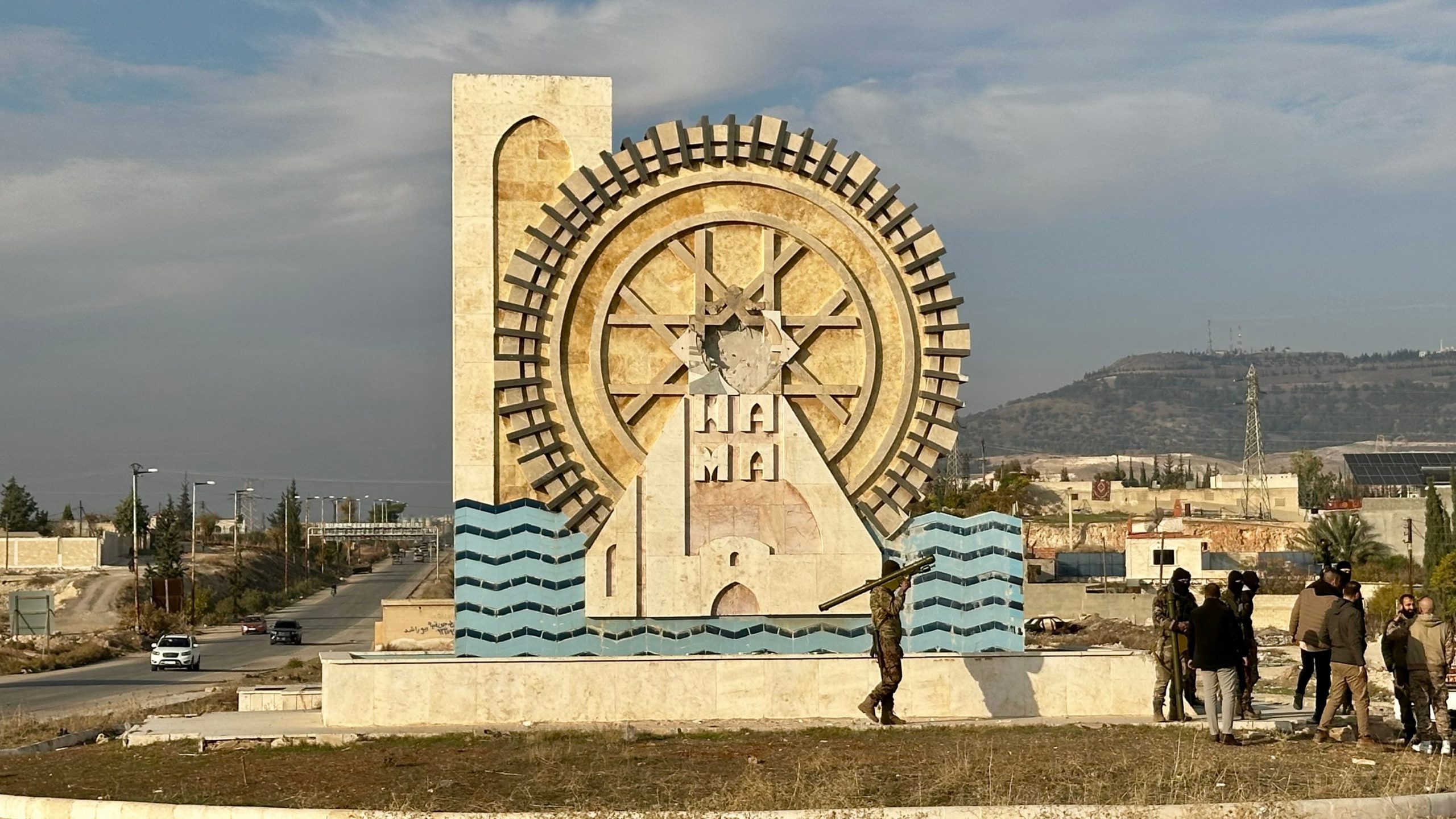
The Hamawi writer Bara Sarraj compares the omnipresence of the massacre in private conversations to the waterwheels of the old city.[46] One of its most famous features, their distinctive sound—described as a ‘moan’ by locals—shapes the urban atmosphere. Similarly, according to al-Sarraj, the secret stories whispered about the massacre formed a constant din in the city, becoming part of its identity. Manhal al-Sarraj describes Hamawi identity after the massacre in Asi al-Dam: ‘Despite the government’s attempts to cover up what happened—the construction of new buildings and the restoration of the destroyed and ruined—the traces of the events were visible on faces and brows. Hamawi—they say it and fall silent. Meaning, oppression, fear, pain, bitter remembrance’.[47]
The novel portrays the identity of Hama’s inhabitants as being reshaped by the massacre, specifically by the violence and memories of the humiliation they endured. As violence continues to pervade daily life and influence the identity of Hamawis, even those who did not see the massacre first-hand become witnesses to it. In other words, denizens of the city who were absent during the massacre or born after it are witnesses to the ongoing violence. That violence did not cease in 1982 and cannot be viewed as an isolated event in the past, but rather as a process that has been unfolding for decades. The violence of the massacre can be categorised as the direct violence that took place in February 1982 and the indirect violence resulting from silence and humiliation. A Hamawi woman describes her understanding of the Hama experience in a text she wrote during the Syrian revolution in 2012:
On its thirtieth anniversary – and I’m four years older than it is – I want to talk about Hama. Even though I didn’t live through the massacre, I lived through Hama. I am not an eyewitness to the killing, the slaughter, the rape, but I am a witness to everything else. And who said that massacres stop at killing and slaughter and rape?[48]
The phrase ‘I lived through Hama’ shows that the city’s name itself has become synonymous with the massacre and its aftermath, which renders living in the city an experience that encompasses the massacre, beyond the physical violence perpetrated in February 1982. The violence is not limited to its physical traces that are visible in the city (the rubble everywhere, on top of which modern buildings were erected), but extends to the psychological level as well. The witness recounts numerous situations and stories from daily life in Hama that she sees as a continuation of the massacre, among them the absence of many of her relatives or the use of certain expressions that reflect uncertainty about their fate.
Despite the passage of time, the impact of the violence on daily life remains clear in many situations and activities that are attributed to or linked to the massacre in the collective memory. In this way, daily life itself becomes part of the violence that was experienced. As Veena Das observes: ‘Thus, just as I think of the event as attached to the everyday, I think of the everyday itself as eventful’. [49] The enduring impact of the massacre is evident in Manhal al-Sarraj’s novels, Kama Yanbaghi li-Nahr and Asi al-Dam, particularly in two intertwined themes: the spatial restructuring of the city and the mystery surrounding the fate of the many people who disappeared during the massacre.
In the aftermath of the massacre, the fate of many Hamawis remained unknown, as they were either arrested, killed, or buried in mass graves without their families’ knowledge. Enforced disappearance was commonplace throughout Syria under the Assad regime—just how common became even more apparent after the fall of the regime, when families began searching for their missing relatives in the now liberated prisons. Yassin al-Haj Saleh, himself a former political prisoner, calls this a ‘normal national experience’, [50] but it was especially salient in Hama, where virtually every family had missing relatives.[51] According to eyewitnesses, the exchange of information about the whereabouts of these people was a central topic of conversation after the massacre. While it was dangerous to mention the loss of a family member in public, information about the fate of individuals was often shared and compared in private.[52] The remembrance of ‘the absentees’, as Manhal al-Sarraj calls them in her novels, is essential to the culture of remembrance that has developed in Hama since 1982. The following scene from Kama Yanbaghi li-Nahr illustrates that the wait for the return of the absentees had a profound impact on life in the city:
At the first improved entrance to the city, small saplings are scattered along both sides of the highway and on the median. They’re new but dried-out and stunted, dusty and sluggish. People spend night and day there. On cold days, they light a fire, gathering around it in silence and patiently waiting. In every season, they wait.
Rumours spread that a group of men is returning from the unknown. They drop what they’re doing and rush over, anticipating the return of a son, father, brother, relative. The people of the city are all kin; everyone’s related to everyone else.[53]
Here we see that the city’s inhabitants waiting for the absentees has become an essential element of what it means to experience Hama in the years and decades following the massacre. Most families in the city have missing relatives, and so they live in a state of constant waiting and uncertainty. Although the missing remain absent, they are simultaneously present,[54] as their loss continues to impact the community and its collective memory. Al-Sarraj describes a mother who lost her son in the massacre, prompting her to prepare an empty grave for him, which she visits regularly.[55] At the same time, she lives as if her son is still alive, allowing everyone to call her ‘the doctor’s mother’, because her son was studying medicine.[56] The uncertainty and constant waiting make it impossible to turn the page,[57] for the ongoing impact of the violence throw up an obstacle that prevents victims (or survivors) from formulating a narrative of events from their own perspective or fully grasping the nature of their experience,[58] precisely because it is unclear and never-ending. The impossibility of constructing a narrative to counter the regime’s version of events is one reason for the silence around the massacre, which in turns perpetuates the official narrative that the massacre never happened.
The regime’s ambition to redefine the identity of the city is clearly manifested in the spatial restructuring that followed the massacre. The dominant narrative of the massacre is not only palpable in the rules of communication and the silence surrounding the events, but also in the city’s geography. The regime instantiated its violence and power in the urban space of Hama, making it visible not only in physical infrastructure but also in the daily practices and lifestyle of its inhabitants. The regime’s conspicuous presence in Hama symbolised its power to control the discourse and its ability to impose its version of events on the public. Spatially, traces of the massacre were manifested in the ruins of destroyed homes and the empty spaces of the city. Even years after the massacre, visitors still spoke of the visible devastation. Despite the passage of forty-three years, the impact of the massacre is evident in the urban landscape: many houses in the area that once made up much of the old city have not been rebuilt, serving as a reminder of the consequences of resisting the regime. In addition, buildings were often erected on top of clearly destroyed homes and, in some cases, on top of mass graves buried under the rubble. Reconstruction was thus inextricably linked to the disappearance of the missing.
In this way, the regime inscribed itself on the urban landscape, and while this process was described as the reconstruction or modernisation of the city,[59] it can be understood as a violent act that perpetuated the experience of the massacre. A prominent example is the Apamea Hotel, built on the ruins of Kilaniya, a neighbourhood in the old city that was completely destroyed in 1982. The Baath Party headquarters—a clear symbol of the regime’s power—was built next to the hotel. Al-Sarraj describes the hotel building, which in her novelistic portrayal represents the centre of communications, as a symbol of the regime’s occupation of the city: ‘Abu Shama’s men ordered the construction of the “smart cell” communications centre on the site of the houses they had entered with tanks and demolished with aircraft. Across from the new building, a huge neon billboard was to be installed atop a tale pole, its blinking lights occupying the river as they reflected on the water’.[60]
The construction of new buildings on top of the ruins of the old city can be read as an extension of the violence that ravaged the old quarters in 1982. The erasure of the city’s history manifested itself on multiple levels: while the rubble and mass graves partially concealed the evidence of the massacre, the destruction also extended to Hama’s ancient history, according to one of the interviewees.[61] The Assad regime sought to entrench itself in the city by claiming control of its future and consolidating its material and symbolic hegemony over it. In her novel, al-Sarraj preserves the city’s historical memory and identity before the massacre while also creating informal spaces for remembrance, as illustrated by a scene that imbues an ordinary staircase in the city with symbolic significance: ‘This swell and slope of the staircase saw heavy traffic during the Nazir–Abu Shama events. Racing along its twists and turns, the city’s inhabitants collided with each, each wanting to return home’. [62]
The novel portrays the staircase itself as a witness to the massacre, an inseparable part of the collective memory of city residents. It becomes an informal reference point that connects the present to the past,[63] where repressed memories of the massacre are embedded,[64] even if they remain invisible to outsiders. By linking specific memories from the time of the massacre to ordinary places in the city, these locations are reshaped into informal memorials that can be understood as a form of resistance to the dominant, official narrative, preserving an alternative version of the past.
Writing for Justice?
In Kama Yanbaghi li-Nahr and Asi al-Dam, Manhal al-Sarraj sheds light on the enormous, lasting impact of the Hama massacre on life in the city and the identity of its inhabitants. The massacre is not merely an event that happened in the past, but rather an ongoing process: the absence of people and the transformation of urban space have made the violence persist for decades. As shown above, a multi-layered silence plays a significant role in perpetuating the violence. Herein lies a fundamental function of literature: to offer an alternative to the imposed silence. While the regime reduced the atrocities to ‘events,’ the two novels reveal the accumulation and continuation of violence in daily life across generations. The narrative of the literary texts thus explicitly contradicts the regime’s official narrative. In this approach, al-Sarraj not only makes an inventory of victims; she shows that the gravest consequences of the massacre are not limited to human casualties but also include humiliation and insult, and the invisible forms of oppression engraved into the collective memory: ‘Some say 30,000 were killed, others 40,000, and while the space between these figures is vast, the word “thousands” is trivial next to the humiliation and oppression etched into the memory of the people and the city’.[65]
Despite the high death toll, al-Sarraj believes that the most serious consequence of the massacre is found in the humiliation—that invisible, abstract dimension. It is from this perspective that the novel gains its legitimacy as an approach to understanding abstract, invisible violence. One of literature’s strengths in this context is its capacity to grapple with violence by conveying emotional truths that may be absent from legal reports or official documents.
For Yassin al-Haj Saleh, the end of the Assad regime is not enough to truly liberate the country; rather, what has been forgotten or deemed taboo by the regime must be revived from the victims’ perspective.[66] Since that the violence of the massacre turned into a protracted process due to a multifaceted, enforced silence, publicly speaking or writing about the events and incorporating them into cultural memory can thus be a form of resistance against violence and a first step towards justice. The role of literature here is to bring the past into the reader’s consciousness, as is the case of Manhal al-Sarraj’s literary works. In her novels, remembrance of the city’s history before the massacre, and especially remembrance of murdered and abducted family members, holds particular significance. This function is embodied in the character of Fatma, for whom recalling her absent relatives becomes a daily ritual and part of her life. It must be emphasised that remembering here is not a frightening and intrusive memory, but a conscious and deliberate process. Fatma repeatedly looks at old photographs and delves into memories as she recalls the past. The following passage highlights the central place the novel gives to these memories, as Fatma contemplates an old family photograph taken before the massacre: ‘Fatma was staring at the lemon branches visible at the top of the photo when she noticed her foot had fallen asleep beneath her. She always means to sit for just a few minutes, then loses herself for hours, intoxicated by the history and chronicling of events’.[67]
In this passage, Fatma’s preservation, recollection, and repeated reliving of memories constitutes a form of historical chronicling and, thus, a rejection of the regime’s official historical narrative. This act can be described as a form of memory-making, as defined by Jelin, through the evocation of the past and the addition of meaning to it.[68]
Similarly, novelists and authors who document memory practices that are invisible to the outside world, and who bring orally transmitted memories to a wider audience, can be considered active agents in the politics of memory. Once targets for repression and discrimination, these writers, by documenting their personal recollections, become active participants in shaping memory politics in Syria,[69] their texts providing a language for the expression of memories and the construction of an independent narrative. Because literary works offer a largely unseen perspective on events within the public sphere, rendering them comprehensible in all their complexity, they can play a role in transitional justice efforts and lend deeper meaning to the concrete facts of the massacre. Moreover, in publishing their literary works, these authors allow an interpretation of the massacre that transcends the ‘fear reflexes’, whose purpose, al-Haj Saleh argues, was to stimulate fear.[70]
To reconcile with the past, it is essential to accurately understand the methods of governance employed by the Assad regime and the social and psychological dynamics that sustained it. Literary works, particularly novels with complex narratives, provide a means of comprehending what cannot be expressed directly. In the context of the Hama massacre, literature allows us to understand the continuation of the violence by documenting the oral narratives of victims and imbuing spaces in the city with meaning, as points of reference linked to a silenced, erased history. Through these representations, literature challenges the regime’s narrative and creates alternative spaces of remembrance, bringing the experiences of voiceless victims into the public discourse. In this way, the survivors and the authors reclaim the power of interpretation over the history and identity of Hama. While literature allows us to preserve silenced memories, it also creates alternative sites of remembrance and the power of interpretation.
Literature serves to document orally transmitted memories, freeing them from the exclusive reliance on oral repetition by committing them to writing. While literary texts offer a means of preserving oral narratives that often remain outside the realm of formal documentation, they also provide a framework through which individual and collective experiences of violence, resistance, and memory can be passed down to future generations.
When formal legal proceedings are virtually impossible—as was the case until recently in Syria—artistic practices are vital.[71] In such contexts, literary works that address past experiences of violence can form the basis for a broader societal debate, which is essential to transitional justice.[72] In this way, fictional narratives can support transitional justice efforts by opening up and reshaping public debate on the causes and effects of violence.[73]
While the Hama massacre was not addressed in public discourse or through systematic, formal approaches; ultimately, remembrance of it is deeply embedded in the Syrian social fabric. Through her literary narratives, Manhal al-Sarraj illuminates the enduring impact of violence and the transformations it wrought on identity and memory, particularly in Hama. Her writings demonstrate that violence is not merely a past event, but an ongoing process reproduced through social mechanisms, foremost among them silence, which functions as a tool to consolidate dominance and perpetuate humiliation.
Literature contributes on multiple levels to reflecting upon and addressing the bloody past, and to achieving social reconciliation. Because literature allows for the expression of what has been suppressed in the public sphere, it becomes a way to reclaim what has been silenced and reintroduce it to the collective consciousness. The power of literature lies in its ability to represent what cannot be articulated or documented in legal or historical language: it conveys the psychological and human impact of violence rather than simply describing the facts. By creating spaces for empathy and shared reflection, literary works may help initiate a societal dialogue about the causes of violence and ways to transcend it.
In this sense, literature does not merely document tragedy; it actively helps reshape collective memory and formulate alternative narratives by turning individual experience into a comprehensible past that can be shared with others. By shedding light on what has been denied or obscured in the public sphere, it opens up alternative spaces for remembrance and complements, rather than replaces, other avenues to transitional justice, permitting us to grasp the human and emotional dimensions of memory that legal and political instruments cannot capture.
AI Assistance Statement
Limited use was made of AI tools (ChatGPT and DeepL) solely for linguistic purposes (e.g., finding synonyms and more precise words). The tools were not used in any way in preparing or developing the academic or intellectual content of this paper.
This article is originally written in Arabic for Rowaq Arabi.
[2] Alasdair Drysdale, “The Asad Regime and Its Troubles,” MERIP 110, no. 9 (1982), https://doi.org/10.2307/3012278; Itzchak Weismann, “Saʿid Hawwa: The Making of a Radical Muslim Thinker in Modern Syria,” Middle Eastern Studies 29, no. 4 (October 1993): 602, https://doi.org/10.1080/00263209308700969.
[3] Amnesty International, Report from Amnesty International to the Government of the Syrian Arab Republic (Amnesty International, 1983), 37.
[4] Middle East Watch, Syria Unmasked: The Suppression of Human Rights by the Asad Regime (Yale University Press, 1991), 20.
[5] Lobmeyer, Opposition und Widerstand, 225; Middle East Watch, Syria Unmasked, 20.
[6] Radwan Ziadeh, Power and Policy in Syria: Intelligence Services, Foreign Relations and Democracy in the Modern Middle East (I. B. Tauris, 2013), 29, https://doi.org/10.5040/9780755692804.
[7] Khalid al-Khani, “Hama 1982,” Dahnon, 2011, accessed 25 March 2024, https://bit.ly/3xvtzTB.
[8] Fawaz Haddad, “An Taktub Riwaya ‘an Majzarat Hama,” al-Arabi al-Qadim, 7 February 2024, accessed 8 February 2024, https://tinyurl.com/23udc2t.
[9] Lisa Wedeen, Ambiguities of Domination: Politics, Rhetoric, and Symbols in Contemporary Syria (University of Chicago Press, 2015), 44, 47, https://doi.org/10.7208/chicago/9780226345536.001.0001.
[10] Hafez al-Assad, “Kalimat al-Ra’is Hafiz al-Asad fi al-Dhikra al-Tasi‘a ‘Ashir li-Thawrat al-Thamin min Adhar,” President Assad website, accessed 5 July 2019, https://bit.ly/2YrKxyU.
[11] Salwa Ismail, The Rule of Violence: Subjectivity, Memory and Government in Syria (Cambridge University Press, 2018), 132, https://doi.org/10.1017/9781139424721.
[12] Amal Hanano, “From Hama to Daraya,” in Syria, eds. Ziauddin Sardar and Robin Yassin-Kassab (Hurst, 2014), 88.
[13] Anna Christina Scheiter, ‘“Hama Lam Tamut’ (‘Hama Did Not Die’): Remembering the Hama Massacre after the Fall of the Assad Regime,” Trafo Blog for Transregional Research, 6 February 2025, accessed 26 September 2025, https://doi.org/10.58079/139ju; Abd al-Jabbar al-Jazamati, “Majzarat Hama: 43 ‘Aman min al-Samt Yankasir,” al-Arabiya, 4 February 2025, accessed 28 April 2025, https://tinyurl.com/592uh7n6; Maladh Qassem Agha, “Li-Awwal Marra Abna’ Hama Yuhyun Dhikra Majzarat 1982,” al-Jazeera, 1 February 2025, accessed 28 April 2025, https://tinyurl.com/3svymd4h.
[14] Scheiter, ‘“Hama Lam Tamut.”’
[15] Raphael Lefevre, Ashes of Hama: The Muslim Brotherhood in Syria (Oxford University Press, 2013); Naomí Ramírez Díaz, The Muslim Brotherhood in Syria: The Democratic Option of Islamism (Routledge, 2017), https://doi.org/10.4324/9781315203928; Brynjar Lia, “The Islamist Uprising in Syria, 1976–82: The History and Legacy of a Failed Revolt,” British Journal of Middle Eastern Studies 43, no. 4 (October 2016): 541–559, https://doi.org/10.1080/13530194.2016.1139442.
[16] Syrian Democrats, Hama: Ma’sa al-‘Asr (National Alliance for the Liberation of Syria, 1983).
[17] Lobmeyer, Opposition und Widerstand.
[18] Ismail, The Rule of Violence.
[19] Astrid Ottosson al-Bitar, “Giving Voice to Silenced Stories in the Novel Kama Yanbaghi li-Nahr [As Is Appropriate for a River] by Manhal al-Sarraj,” Orientalia Seucana 40 (2010): 73–84; Astrid Ottosson al-Bitar, “And There Was Complete Silence: Silence as Theme and Narrative Strategy in Three Syrian Novels,” in La littérature à l’heure du printemps arabe, eds. Sobhi Boustani, Rasheed El-Enany, and Walid Hamarneh (Karthala, 2016), 211–226.
[20] Brigitte Herremans, Countering Erasure and Invisibilisation: The Potential of Literature to Open Up the Justice Imagination in the Syrian Context, (PhD diss., Ghent University, 2023).
[21] Brigitte Herremans and Tine Destrooper, “Moving Beyond Formal Truth Practices and Forensic Truth in the Syrian Conflict: How Informal Truth Practices Contribute to Thicker Understandings of Truth,” Social and Legal Studies 32, no. 4 (2023): 520, https://doi.org/10.1177/09646639221134965.
[22] Ibid., p. 527.
[23] Ibid., 519.
[24] Elizabeth Jelin, Los Trabajos de la Memoria (Siglo XXI de España Editores, 2002).
[25] Elizabeth Jelin, The Struggle for the Past: How We Construct Social Memories (Berghahn Books, 2021), 3.
[26] Jelin, Los Trabajos, 14, https://doi.org/10.1515/9781789207835.
[27] Jan Assmann, Das kulturelle Gedächtnis: Schrift, Erinnerung und politische Identität in frühen Hochkulturen (C. H. Beck, 2018), 42, https://doi.org/10.17104/9783406703409.
[28] Ibid., 35.
[29] Aleida Assmann, Formen des Vergessens (Federal Centre for Political Education, 2018), 47.
[30] Maurice Halbwachs, Das Gedächtnis und seine sozialen Bedingungen (Suhrkamp, 1985), 189.
[31] Based on observations of a person I interviewed in a field visit to Hama and casual interviews with several residents of the city in February 2025.
[32] Moritz Bassler (ed.), New Historicism (Francke, 2001), 22–23; Michael Payne, “Introduction: Greenblatt and the New Historicism,” in The Greenblat Reader, ed. Michael Payne (Blackwell, 2005), 3.
[33] Yassin Haj al-Saleh, “al-Mansa al-Suri, al-Mansa al-Suriya,” al-Hiwar al-Mutamaddin, 20 October 2013, accessed 20 September 2025, https://tinyurl.com/5n7vuz4z.
[34] Dima Wannous, al-Kha’ifun (Dar al-Adab, 2017).
[35] Ismail, The Rule of Violence, 132.
[36] Interview with S. S., 8 September 2020.
[37] Manhal al-Sarraj, Kama Yanbaghi li-Nahr (Manshurat al-Ikhtilaf, 2007). Originally published in 2003.
[38] Manhal al-Sarraj, Asi al-Dam (Dar al-Adab, 2012).
[39] Shoshana Felman, “Benjamin’s Silence,” Critical Inquiry 25 (1999): 205–207.
[40] Al-Sarraj, Asi al-Dam,181.
[41] Al-Sarraj, Kama Yanbaghi li-Nahr, 50.
[42] Dori Laub, “An Event without a Witness: Truth, Testimony and Survival,” in Testimony: Crises of Witnessing in Literature, Psychoanalysis, and History, eds. Shoshana Felman and Dori Laub (Routledge, 1992), 79.
[43] Interview with Khalid al-Khani, 18 May 2020; interview with Zahir Omarayn, 21 April 2020.
[44] Interview with Khalid al-Khani, 18 May 2020.
[45] Interview with Zahir Omarayn, 21 April 2020; interview with Khalid al-Khani, 18 May 2020.
[46] Bara Sarraj, “Hama: Post-Massacre,” Jadaliyya, 7 March 2012, accessed 24 January 2023, https://tinyurl.com/39va7s2y.
[47] Al-Sarraj, Asi al-Dam, 225.
[48] Sumaya, “Jarah al-Dhakira: Fi Dhikra Hama,” Qisas min al-Thawra al-Suriya, 2 February 2012, accessed 24 January 2023, https://tinyurl.com/yc2fm4n3.
[49] Veena Das, Life and Words: Violence and the Descent into the Ordinary (University of California Press, 2007), 8, https://doi.org/10.1525/9780520939530.
[50] Yassin al-Haj Saleh, “Ma Ba‘d Adab al-Sujun: Shart al-Shatat al-Suri wa-Ilzam al-Muqarana,” Dawn MENA, 5 April 2021, accessed 19 March 2024, https://bit.ly/3PSH1az.
[51] Al-Khani, “Hama 1982.”
[52] Interview with Khalid al-Khani, 18 May 2020; interview with Zahir Omarayn, 13 May 2025; interview with S. S., 29 April 2025.
[53] Al-Sarraj, Kama Yanbaghi li-Nahr, 135.
[54] Pauline Boss, Ambiguous Loss: Learning to Live with Unresolved Grief (Harvard University Press, 1999), 106, https://doi.org/10.4159/9780674028586.
[55] Al-Sarraj, Kama Yanbaghi li-Nahr, 87.
[56] Ibid., 130.
[57] Laura Menin, “A Life of Waiting: Political Violence, Personal Memories, and Enforced Disappearances in Morocco,” in The Social Life of Memory: Violence, Trauma, and Testimony in Lebanon and Morocco, eds. Norman Saadi Nikro and Sonja Hegasy (Palgrave Macmillan, 2017), 36, https://doi.org/10.1007/978-3-319-66622-8.
[58] Ibid.
[59] Patrick Seale, Asad of Syria: The Struggle for the Middle East (I. B. Tauris, 1988), 334.
[60] Al-Sarraj, Kama Yanbaghi li-Nahr, 109.
[61] Interview with S. S., 8 September 2020.
[62] Al-Sarraj, Kama Yanbaghi li-Nahr, 50.
[63] Aleida Assmann, Der lange Schatten der Vergangenheit: Erinnerungskultur und Geschichtspolitik (C. H. Beck, 2006), 218, https://doi.org/10.17104/9783406622625.
[64] Assmann, Das kulturelle Gedächtnis, 38.
[65] Al-Sarraj, Asi al-Dam, 151.
[66] Al-Haj Saleh, “al-Mansa al-Suri.”
[67] Al-Sarraj, Kama Yanbaghi li-Nahr, 9.
[68] Jelin, Los Trabajos, 30.
[69] Susanne Buckley-Zistel, “Spatializing Memory and Justice in Transformation Processes,” in Re-Configurations: Contextualising Transformation Processes and Lasting Crises in the Middle East and North Africa, eds. Rachid Ouaissa, Friederike Pannewick, Alena Strohmaier (Springer, 2021), 31, https://doi.org/10.1007/978-3-658-31160-5_2.
[70] Al-Haj Saleh, “al-Mansa al-Suri.”
[71] Herremans, “Countering Erasure and Invisibilisation,” 297.
[72] Ajla Demiragić and Edin Hodžić, “The Bleak Visions of Literary Justice for Survivors of Srebrenica: Examining the Fictional Narratives of Srebrenica Genocide in Light of the Insights from Transitional Justice,” in The Arts of Transitional Justice: Culture, Activism, and Memory after Atrocity, eds. Peter D. Rush and Olivera Simić (Springer, 2014), 138, https://doi.org/10.1007/978-1-4614-8385-4_8.
[73] Ibid., 37.
Read this post in: