
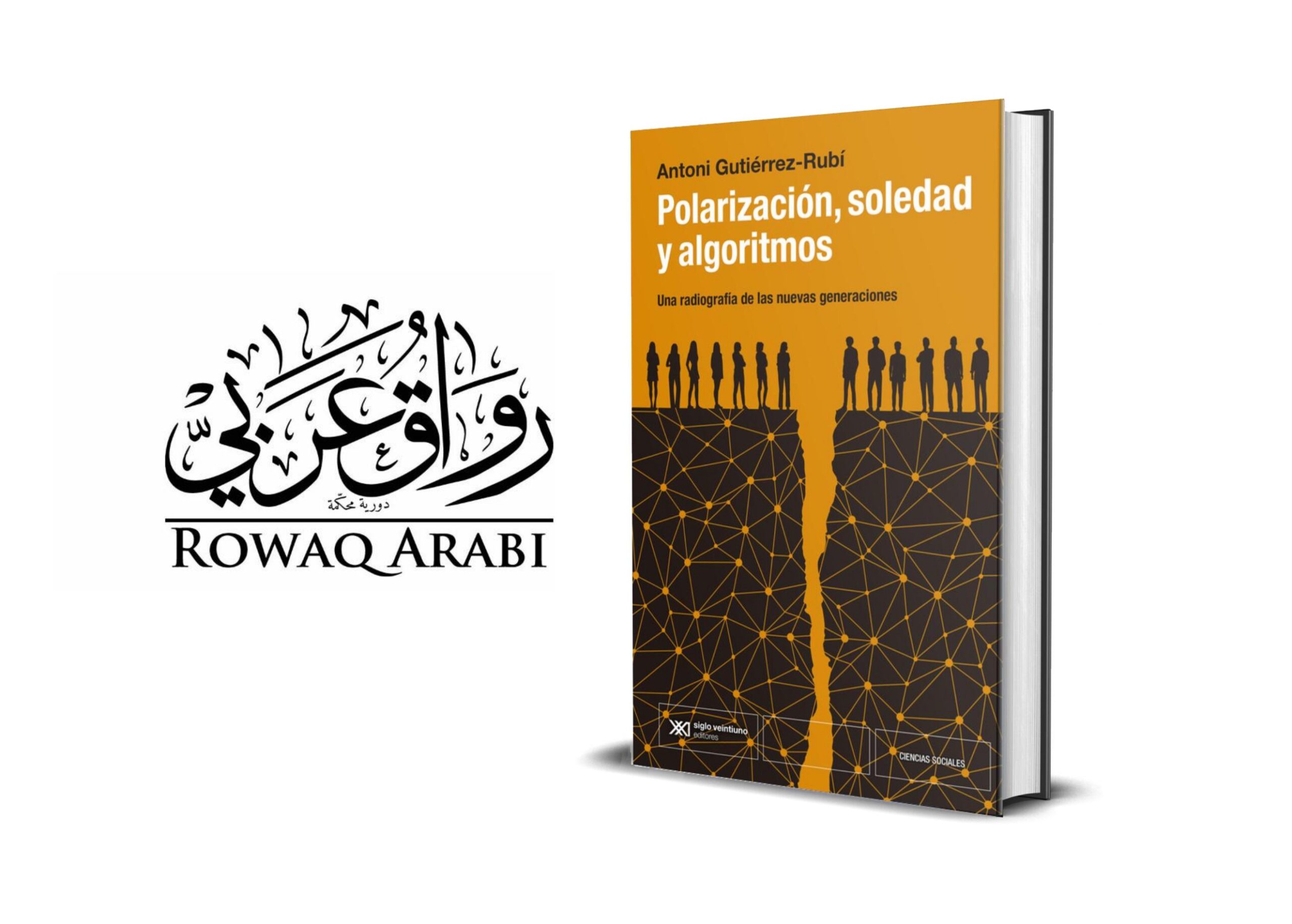
Citation: Zaanoun, Abderrafie. 2026. “Book Review: ‘Polarisation, Isolation, and Algorithms’ by Antoni Gutiérrez-Rubí.” Rowaq Arabi 31 (1): 5-9. https://doi.org/10.53833/ULWX1340.
Title: Polarisation, Isolation, and Algorithms: An Anatomy of the New Generations
Author: Antoni Gutiérrez-Rubí
Publisher: Siglo XXI Editores (Madrid)
Year of Publication: 2025
ISBN: 978-84-323-2147-4
The political implications of technology are examined by the work of Antoni Gutiérrez-Rubí, a Spanish writer and international expert in political communication. His publications include Politics Under Scrutiny: Political Communication in the Era of WikiLeaks (2011), Politics in the Age of WhatsApp (2015), and the focus of this review, his latest book Polarisation, Isolation, and Algorithms: An Anatomy of the New Generations (2025). Across eight chapters, the book systematically analyses Generation Z; the characteristics that have defined them, the crises and contexts that have shaped them, the influence of social media on their lives, and their place in contemporary cultural and political struggles. The book also explores how political communication can be recalibrated to engage new generations and restore their trust in democracy.
Methodologically, Gutiérrez-Rubí adopts a critical reading of generational theories and ultimately adopts the American classification model, which distinguishes six major cohorts: the Silent Generation, Baby Boomers, Generation X, Millennials (Generation Y), Generation Z, and Generation Alpha. To ensure empirical breadth and representativeness he draws on multiple sources, including public opinion data (Demoscopic data) from specialised international institutions and in-depth interviews with nine American and European experts in public policy, political demography, social anthropology, digital innovation, and data analysis. In addition, the author conducted a series of focus groups with Generation Z participants to gain first-hand insight into their concerns and aspirations.
Utilising the above sources, the book asserts that Generation Z is arguably the most frustrated cohort among living generations. According to the 2024 World Happiness Report, individuals aged fifteen to twenty-four report the lowest levels of happiness of any age group.[1] Gutiérrez-Rubí attributes this finding to the successive crises this generation has endured, with their childhood strained under the 2008 global financial crisis and adolescence constrained under the restrictive measures imposed during the COVID-19 pandemic. Their coming of age has also coincided with the intensification of the climate crisis, the repercussions of the Russia-Ukraine war, and the brutal backlash against protests in solidarity with Palestinians and victims of racism.[2] These and other developments have compounded feelings of social neglect and dissatisfaction with living conditions. One indicator is the decline in economic independence, reflected in the high proportion of young people under thirty who continue to live with their families—up to sixty-six per cent in the United States and between fourteen and twenty per cent in China and most European Union countries—largely due to rising unemployment and delayed entry into the labour market. This has generated a pervasive sense of failure among youth and an inability to achieve the independence their parents and grandparents once took for granted.[3]
The book identifies a key political consequence of this accumulated frustration—namely, a nostalgic idealisation of the historical circumstances in which earlier generations lived, coupled with a growing openness to authoritarian rule. Citing the 2023 Open Society Barometer, Gutiérrez-Rubí notes that forty-two per cent of young people under the age of thirty-five across thirty countries consider military rule a preferable form of government.[4] The data also point to a growing attraction to populist currents that challenge liberal-democratic values, a trend echoed in electoral patterns across the globe. In France, support among voters under twenty-five for the National Rally rose from twelve to twenty-nine per cent between 2019 and 2024. In Portugal, the right-wing Chega party expanded its parliamentary representation from twelve to fifty seats in 2024, becoming the third-largest force in parliament. Far-right parties hostile to pluralism and migrants’ rights, such as the Alternative for Germany (AfD) and Austria’s Freedom Party (FPÖ), have seen their support grow markedly among younger voters. In Argentina, Javier Milei secured victory in the 2023 presidential runoff with roughly seventy per cent of the vote among under-twenty-fives, buoyed by anti-establishment rhetoric and the strategic use of digital tools for outreach and mobilisation.
Against this backdrop, the author argues that far-right parties are poised to capture a majority of the youth vote for two principal reasons. First, populist narratives appeal to a generation marked by ‘cumulative frustration’ resulting from successive crises. Attributing the economic and social crises to the perceived failures of the political system fuels support for anti-establishment movements. Second, populist right movements have mastered the ability to speak a language that young people understand, leveraging influencers and podcasters with large youth followings and mobilising organised online networks to dominate social media spaces. They achieve this through the relentless dissemination of visual content tailored to the aspirations of the new generation, powered by algorithms designed to especially target politically disengaged young men.
Digital platforms such as TikTok and Instagram have brought about a profound shift in the reference points shaping electoral behaviour, moving away from the influence of family members and friends towards non-traditional media sources. These sources can lead the youth to adopt political positions at odds with those of older people with whom they share the same roof and sometimes, in the author’s words, ‘the same bed’.[5] The growing influence of algorithms and content creators on how Generation Z votes further compound this dynamic, posing significant challenges to contemporary electoral campaigning. These challenges are likely to intensify as the electoral weight of this generation grows, with its youngest members reaching voting age by 2030.
Gutiérrez-Rubí therefore anticipates that these platforms—through tools designed to capture attention and shape thinking—may become the sole source of young people’s political identity formation. Two such algorithmic tools are the infinite scroll, which displays content in a continuous, automatic flow rather than in discrete sections, and filter bubbles, which enclose users within content aligned with their pre-existing interests. Together, they create fertile ground for isolating young users within ‘echo chambers’ that push them towards extreme positions on political and social issues. This dynamic is no longer limited to TikTok. Silicon Valley giants, too, have begun developing political software that serves the interests of states and parties seeking to control young audiences—including generative AI systems calibrated to provide biased responses.[6]
Adding further nuance to this picture, the author unpacks the often-misunderstood relationship between Generation Z and politics. The claim that this generation is the most self‑interested, he contends, is largely unfounded, as its more politically engaged members have displayed a pronounced commitment to social justice. This is evident in youth-led movements worldwide that confront climate change, inequality, and various forms of discrimination, as well as in their prominent role in protesting the Israeli war on Gaza despite facing significant repression. On the other hand, the growing sense of political underrepresentation is driving many young people to support authoritarian regimes and movements. This places responsibility for democratic institutions and parties to adapt to this reality if they hope to strengthen their connections with younger generations.[7]
Beyond immediate electoral implications, the book highlights how digital habituation is structurally transforming the very concept of democracy. Raised in digital environments that normalise instantaneous reactions and quick fixes, many young people have come to expect rapid solutions to long‑standing problems, often without appreciating the complexity of political systems or the institutional processes of policymaking.[8] The consequences of digital isolation now extend beyond social life and psychological well‑being to include the erosion of the public sphere, as the appeal of collective participation recedes. This erosion, the author argues, makes it imperative to reimagine the democratic system to better accommodate ‘new citizens’—by lowering the voting and candidacy age to sixteen and by developing more advanced forms of digital democracy capable of strengthening the values of citizenship and dialogue.[9]
That said, Gutiérrez-Rubí’s analysis remains bound to Western-centric assumptions in his analysis of the political dynamics of Generation Z youth, particularly in assuming that these groups are more inclined to support far-right movements in Europe and North America. At the same time, his analysis suggests that they are more distant from conservative currents in the countries of the Global South. Empirical evidence, however, indicate that young people have been behind the outbreak of uprisings in several Asian and African countries. Some of these movements have brought unprecedented political changes, as in the cases of Bangladesh, Nepal, and Kenya. Through innovative forms of protest that have disrupted both the structures and discourses of power, young people find themselves at a new turning point. Amidst widening socio-economic disparities, they may yet become a pivotal force for democratic change.
To maximise the pro-democratic potential of the new generation, Polarisation, Isolation, and Algorithms calls for a thorough understanding of these young people that enables responsiveness to their needs. Rather than leaving Generation Z vulnerable to far-right currents that thrive on their disillusionment, Gutiérrez-Rubí puts forward proposals for retooling political communication to meet their demands. These include drawing on the vast pools of data generated by youth‑oriented platforms to identify the most pressing concerns of this critical electoral bloc and deploying carefully designed digital strategies that balance authentic political messaging with engaging forms of outreach. Such an approach, he argues, can strengthen young people’s sense of being politically represented or heard by those in power. In addition, the author calls for public policies responsive to the aspirations of younger generations, which would help restore their confidence in democracy and the virtues of representative government.
In this regard, the book highlights specific pioneering policy initiatives that have treated digitally-driven isolation as a political problem—among them Japan’s 2021 establishment of a cabinet-level Ministry of Loneliness and Isolation, tasked with developing innovative solutions to reduce social distancing and youth isolation, and Barcelona City Council’s implementation of a comprehensive strategy to combat social isolation (2020–2030). The latter includes multiple projects aimed at mitigating the consequences of intensive social media use and facilitating the integration of younger generations into public life through training programmes, cultural activities, and in-person discussion forums that encourage young people to engage with public officials and with one another away from the digital sphere.[10]
AI Assistance Statement
Google Gemini was used to verify the translation of certain technical terms from Spanish to English.
This article is originally written in Arabic for Rowaq Arabi.
[1] Antoni Gutiérrez-Rubí, Polarización, soledad y algoritmos: Una radiografía de las nuevas generaciones [Polarisation, Isolation and Algorithms: An X-Ray of the New Generations] (Madrid: Siglo XXI Editores, 2025), 19.
[2] Ibid., 58–59.
[3] Ibid., 20.
[4] Ibid., 24.
[5] Ibid., 53.
[6] Ibid., 156–57.
[7] Ibid., 167.
[8] Ibid., 32.
[9] Ibid., 76.
[10] Ibid., 134.
Read this post in: