
Citation: Shama, Nael. 2026. “Views: Shadowed Past, the Dynamics of Remembrance and Forgetting in the Arab World.” Rowaq Arabi 31 (1): 32-40. https://doi.org/10.53833/RSUY4334.
Controversy was stirred by prominent Egyptian journalist Ibrahim Eissa in October 2025 when he questioned the utility of remembering the Bahr el-Baqar incident in a hoped-for age of peace. The 1970 bombing of that village’s primary school by Israeli jets, which harvested the souls of dozens of pupils, has been deeply entrenched in Egyptians’ collective consciousness. Peace requires managing national sentiments differently, Eissa posited; specifically, by abandoning hatred and forgetting historical wounds. ‘Don’t say, “We can’t forget what the Israelis did in Bahr el-Baqar.” Why not? Really? Haven’t we already forgotten the massacres of January 25, 1952, and Denshawai for the English?’[1]
Albeit somewhat inadvertently, Eissa’s parenthetical remarks touch on crucial issues that have been overlooked in contemporary Arab thought. In prevalent online Arab fashion post-Gaza genocide, the moment Israel enters the discussion, the room for dispassionate debate regrettably and sharply narrows. An opportunity for constructive debate about key themes like memory, amnesia and silence is therefore lost. The 1980s and 1990s saw a boom in memory studies, an interdisciplinary field drawing on concepts and methods from an array of disciplines, including philosophy, history, sociology and psychology. This has spurred wide scholarly interest in the nature and dynamics of both collective (or social) memory and collective forgetting.
Both collective memory and collective forgetting are of high salience to the status of human rights in the Arab world and thus merit critical attention, as forgotten pasts invite impunity and future crimes. Therefore, a clearer understanding of the dynamics through which memory functions can assist the human rights community in developing effective advocacy strategies, improving methods of accountability, and maximising the chances of avoiding a repetition of past violations.
Collective Memory: Crucial yet Selective
Collective memory is the shared recollections and perceptions of the past. Because the present is ‘fleeting, effervescent, [and] uncatchable’ as philosopher Louis Pojman elegantly observed,[2] memory is what provides social groups with a sense of themselves and the world around them. Through group narratives and representations of bygone times that connect past to present and future, societies create a meaningful sense of cultural continuity. As Kierkegaard astutely explained, life must be lived forwards but can only be understood backwards.[3] Historical narratives enable groups to achieve a state of ontological security: a routinised and stable sense of self needed to cope with the anxiety of existence and the uncertainty of the future. Conceivably, no one expressed this better than the French novelist Marcel Proust, who likened memory to a rope lowered from heaven to rescue the human soul from the abyss of nothingness.[4]
Similar to many other global regions, the received wisdom in the Arab world is that memory is an unquestionable virtue that ought to be evoked, nurtured, cherished and celebrated.[5] Rooted in the effort to safeguard scripture and cultural lineage, many Arabs exhort themselves to remember the past and never lose sight of the lessons of history; its peaks and valleys, glories and sores. Otherwise, the thinking goes, their fate would be sealed. For, as George Santayana famously said, ‘Those who cannot remember the past are condemned to repeat it’.[6] Little wonder that one of modern Arab literature’s most resonant lines is Nobel laureate Naguib Mahfouz’s pithy phrase: ‘Forgetfulness is the plague of our alley’.[7] More precisely, oblivion is the scourge responsible for the nation’s much-lamented falling behind.
Memory, however, often diverges from logic and truth. What people know–or rather, think they know–about the past is hardly a decent reflection of it. Much of what is canonised within national memory is either manufactured or imagined, while many noteworthy past events are denied, downplayed, trivialised, absurdified, jettisoned, or effaced, lying dormant in the womb of silence. Indeed, national memories are often so flawed as to forget monstrous atrocities. A recent survey found a substantial lack of Holocaust knowledge among young adults in several Western countries, including Germany.[8] Genocide scholars note that while the ‘Big Five’ genocides of the twentieth century–the Armenian Genocide, the Holocaust, Cambodia, Rwanda and Bosnia–are widely remembered worldwide, many other cases of mass extermination have been consigned to oblivion–with mass murderers often ‘airbrushed out of history’ to use Milan Kundera’s eloquent expression.[9] One scholar, René Lemarchand, dedicated an entire volume to ‘forgotten genocides’,[10] giving some credence to De Gaulle’s saying that ‘Nothing dries faster than blood’.
Lost or distorted memories are the product of two processes: one natural and innately human, and the other manufactured and self-serving. To be sure, the decay and arbitrariness of memory is a natural occurrence in both individuals and groups. As time passes, recollections of past events, including traumatic events, wane in the collective memory, especially as older memories make room for more recent ones. The now cliché phrase ‘lest we forget’, coined by the English poet Rudyard Kipling in 1897, reflects the realisation that the fading of memory is nearly inescapable unless vehemently opposed. In short, memory has a biological lifetime. Classical Islamic thought recognised this, offering interpretations that the word ‘insan’ (human being) was named this way because of humans’ instinctive disposition towards forgetfulness (nisyan).
This predominantly applies to the fast-paced modern age where people have shorter attention spans and younger generations embrace different worldviews and preferences over the significance of past events. In this era of rapid change, the meaning of ‘new’ has acquired distinct connotations: every passing moment is seen as unique, unprecedented and detached from its predecessors.[11] It is thus generally believed that societies at a standstill tend to remember, often to the point of obsession by a ‘cult of memory’,[12] whereas those undergoing transformation tend to forget.
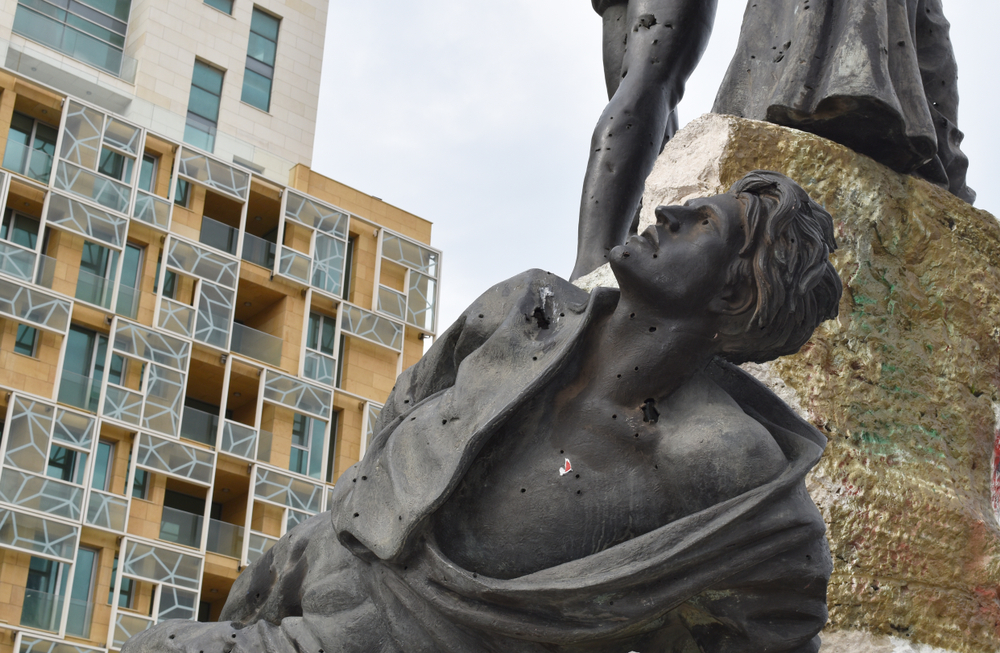
More importantly, there is the pivotal role of power dynamics in shaping what people remember, forget, love, loathe, revere and despise about the past. Jacques Derrida pointed out that there is no exercise of power without mastery of the records, if not of memory itself.[13] States, regimes and ruling elites well know that hegemony, as explained by Antonio Gramsci, is predicated not only on force, but also on consent.[14] As part of a larger framework of values, meanings, beliefs, biases and prejudices forged to uphold dominant power structures, significant efforts are exerted to shape people’s shared memory, often through its deconstruction and reconstruction. While collective forgetting can be imposed through denial, neglect and punishment, collective remembrance can be imposed using weapons of mass persuasion. These typically include rhetoric, forms of cultural production such as poetry, songs and films, and ostentatious public spectacles, including museums, monuments, plaques, cemeteries and commemorative celebrations. Although much of this is kitsch, smothered in reality-distorting sentimentality,[15] it can be very effective. Using elements of exaggeration and understatement, even glorification and concealment, the engineering of memory can go as far as to legitimise myths and delegitimise facts–clearly a manifestation of what Pierre Bourdieu termed symbolic violence.[16] We know from George Orwell the extent to which this may reach in authoritarian regimes: A total inversion of language substituting every truth with its contradiction. In parallel, it causes mnemonic silence, even when there is an elephant in the room.[17]
In the Arab world, where authoritarianism is ubiquitous and freedoms are curtailed, attempts to manufacture oblivion are pervasive. This extends to all the state wrongdoings, including genocidal acts. The mass killings of civilians in Syria’s Hama (1982) and the Kurdish countryside in northern Iraq (1987–1988), better known as the Anfal Campaign, are two illuminating cases in point. For many years, both massacres were kept under thick wraps, with attempts to break the silence punished by the regime in Damascus and Baghdad, respectively.[18] National memories in Arab states are further distorted by propaganda–to put it charitably, or by sheer deceit – to put it more accurately. Twisting facts in Orwellian fashion, palace coups are depicted as great revolutions, criminals morph into demigods, dissidents are castigated as terrorists. and popular revolts coiled into foreign conspiracies. Mythmaking is also prevalent, extending from the nation’s imagined hoary origins to the manufactured genius of its leader.
To Remember or Not to Remember
Whatever its flaws, there is admittedly a strong case to be made for remembrance. Memory is the bedrock of identity and nationalism. ‘No memory, no identity; no identity, no nation’, the leading scholar in studies of nationalism, Anthony Smith, wrote.[19] It is arguably impossible for a society to move toward a viable future if it suffers from amnesia about the past. From a human rights perspective, the crimes of the past are remembered to prevent their recurrence in the future. Simply stated, the guiding principle is ‘never again’. No clear conscience wants to see a future tyrant use the oblivion of past crimes to justify committing new ones, echoing Hitler’s infamous 1939 question: ‘Who, after all, speaks today about the annihilation of the Armenians?’[20]
Furthermore, memory is intrinsically linked to the question of moral responsibility: The living speak for dead victims, make their voices resonate, and secure justice by chasing the perpetrators of malfeasance. In a sense, this–as Walter Benjamin wrote–will ‘awaken the dead, and make whole what has been smashed’.[21] In other words, the burial of the deceased must not entail the burial of their cause. Remembrance as such is a means for assigning political blame and legal responsibility, thereby ultimately realising justice. If approached this way, memory turns into a weapon in the hands of the victims, and the past ceases to be a refuge, instead becoming a compass. On the other hand, forgetfulness, being employed to perpetuate the subordination of the oppressed, is the antonym of justice. Summarising the position of the proponents of remembrance, historian Yosef Hayim Yerushalmi wrote that the ‘terror of forgetting’ far outweighs the danger of possessing an excess to remember.[22]
One ought to pause before fully embracing this view as a similarly valid case can be made for forgetting. When it comes to protracted historical conflicts, forgetting begets healing, a process critical for precluding acts of revenge from spiralling into endless cycles of vicious bloodletting. Surely, Proust’s prophetic rope of memory can either save people or tether them.[23] The notion of forgetfulness was for this reason highly valued by many ancient cultures. In Greek mythology, for instance, the river Lethe embodied forgetfulness, with its flowing waters seen to be cleansing the soul and renewing life;[24] in contemporary jargon, life goes on. The Edict of Nantes by King Henry IV of France in 1598 specifically forbade the remembering of any injuries or offences committed during the French Wars of Religion. Similarly, the 1648 Treaty of Westphalia, which ended the Thirty Years’ War, included a provision for the ‘eternal oblivion’ of all actions committed by the warring parties. More recently, Spain’s post-Franco transition to democracy enshrined a Pacto del Olvido (Pact of Forgetting) into an amnesty law. In a similar vein, the Irish literary critic Edna Longley called on her countrymen to raise ‘a monument to Amnesia’ and forget where it had been put. The legal concept of amnesty–intended for societal reconciliation and peacebuilding–evolved from this spirit.
In a nutshell, if remembering serves justice, forgetting serves peace. Under some circumstances, this may trigger a tough trade-off, especially since peace is in and of itself a just endeavour. Provided that oblivion is thought to facilitate the transition to a new, moral and enduring political order, it might be wise to allow it to prevail over memory. The future is more important than the past after all. At any rate, fuelled-by-memory justice should only be applied to individuals directly responsible for crime, not expanded to entire groups long after the perpetrators are dust.
The dialectic relationship between memory and oblivion could not be more relevant for Arab societies divided along sectarian or ethnic lines, such as Lebanon, Syria and Iraq. Plagued by a history of crass inter-ethnic violence and deep resentment, the crushing burden of memory continues to stoke, for many, the furnace of hatred or even its veneration, as best captured in Syria’s case by Khalid Khalifa’s compelling novel In Praise of Hatred.[25] In such toxic settings where yesterday’s victims could swiftly become tomorrow’s victimisers, unfading memories outlive their benefit. Alternatively, forgetting and letting go leads to closure and new beginnings. Oblivion as such offers a cathartic solution, quelling ethnic conflicts charged by recollections of historical grudges. This directly pertains to intergroup relations in post-conflict Arab societies, including Sunnis and Shi’as in Iraq, Sunnis and Alawites in Syria and among different sects in Lebanon.
Moreover, as reformist Arab philosophers emphasised, the Arab psyche arguably tends to dwell on the past rather than ponder the future.[26] The problem is that overabundant remembering comes at a cost: being trapped in the past, hostage to the brunt of its wounded memories. Undoubtedly, an excess of remembering could be as socially and mentally detrimental as an excess of forgetting.[27] Whether to remember or forget is therefore not a binary question or choice; rather, it is a complex question of what and how much to retain and to discard.
Past Misremembered, Present Forgotten
If collective memory is selective due to the twin processes of organic and forced oblivion, what resulting landscape of memory has been produced in the Arab world? It could be argued that the collective memory of a multitude of Arab publics has forgotten some events that ought to be remembered while clinging to pointless and deleterious memories. The political exploitation of ancient memories by states, non-state actors and religious authorities to feed the flames of millennia-old Sunni-Shi’a discord is–especially in the post-2011 landscape–is a glaring case in point of an injurious memory. A recent episode in this memory-fuelled saga involved the television premiere of a series about a divisive Islamic figure, the Umayyad Caliph Muawiyah, drawing rebukes from Shi’a Muslims. Likewise, habitually invoking the Battle of Khaybar, in which the early Muslims prevailed over the Jewish community of Khaybar, as a mobilising tool against Israel is misguided and unjust. The distinction between Israel and Jews or Judaism has long become self-evident. A 2025 survey by the University of California and the University of Rochester found that only thirty-one per cent of American Jews supported Israel’s military campaign in Gaza.[28] Many Jewish intellectuals around the world, including names of great stature such as Judith Butler and Jonathan Glazer, have spoken against what they described as the hijacking of Jewishness by Israel.
Strained relations with the West are further complicated, in part, by inflaming bitter past encounters. These include the memory of the medieval fall of Muslim rule in al-Andalus (the Iberian Peninsula), a historical event that remains painfully alive in the Arab consciousness. Similarly, references by religious and secular elites alike to the Crusades and the Crusaders are common today,[29] though they were conspicuously absent from the writings of medieval Muslim historians, who used other appellations like ‘Francs’.[30] This also holds true for Saladin, the twelfth century’s military commander, who recaptured Jerusalem from the Crusaders in 1187. No doubt, the shocks of colonialism and the establishment of the state of Israel fired up the resurgence of these memories. The analogy between past and present is obvious: The loss of Palestine, like the fall of al-Andalus, is the work of crusaders (modern-day ones); its undoing awaits the rise of a new Saladin. Suffused with wounds and hopes, this is memory as solace, morale boost, or defence against hard realities, as well as a promise that past triumphs would be revived, but not necessarily as historical truth.
Even concerning more recent events, the Arab collective memory has been marred by pervasive inconsistencies, owing in part to imbalanced reporting and political machinations. While the Arab consciousness has disproportionately gazed upon Gaza, immersing itself in its tragedy, other regional calamities have nearly sunk into obscurity. Sudan’s brutish civil war, which has produced the world’s largest internal displacement crisis, is one of those.[31] In a region fittingly described as an anthropologist’s paradise, the grievances of ethnic and religious minorities are relegated to the margins of memory. Many in the Arab world, including Iraq, had a hazy knowledge of the Yazidis until the barbaric crimes committed against them by the Islamic State in Iraq and Syria (ISIS) made headlines in 2014–2017.[32] The landslide majority in the 2011 referendum that led to South Sudan’s secession took many Arabs by surprise, owing to their oversight of Southern discontent that sustained decades of civil war. The question of the Western Sahara, whose people are denied the right of self-determination, is surrounded by a deafening silence.
Similar instances of oblivion exist concerning internal affairs. Tyranny and widespread human rights abuses in many Arab countries are either overlooked or normalised and defended by some social segments. This is because the longevity of authoritarian rule, alongside its strict narrative control, has led some of the ruled to internalise the rulers’ logic.[33] Consequently, to pay obeisance to authority and serve its objectives–above all, security–the rights of people are readily shunned as part of business as usual. Unsurprisingly, the Arab Uprisings of 2010–2011, the largest occurrence of mass mobilisation in recent Arab history, have thus been mostly banished, appropriated, or forgotten.
The Takeaway
A number of fundamental points can be inferred from the previous discussion. First, given that it is selective rather than comprehensive, collective memory comprises both remembrance and forgetfulness. Said differently, a measure of forgetfulness is inherent in remembrance and vice versa. Memory, in short, is a process of both retention and omission. Second, collective memory is neither static nor unified as it is conventionally conceived, nor is it the straightforward retrieval of past events. Rather, the past is subject to constant processes of deconstruction, reconstruction, alteration and replacement, mostly in service of present needs and interests. The past is thus unpredictable, so to speak. Third, collective memory’s vulnerability to manipulation and mythologisation, and its intrinsic selectivity and embellishment, provide sufficient ground for doubt and scrutiny. Smelling a rat with official memory should encourage the rise of peoples’ counter-memories[34] or underground memories.[35] True, memory is a social construct mediated through other collective constructions such as language and social values. However, if its content rings hollow, free minds should challenge and oppose it. Within this context, the Internet’s capacity to lift the veil from hitherto hidden memories can fill some of what Hannah Arendt portrayed as ‘holes of oblivion’.[36]
From this it follows that memory, being passed from one generation to another and throughout subjected to official engineering, is not exactly a ‘memory’ in the strict sense of the term. Indeed, rewriting memory is restructuring the future. For the same reasons, though often adorned as historical fact, memory is not synonymous with history, nor should it substitute history. While history strives to be an objective and evidence-based field of study, memory is subjective, ephemeral, often fictitious, and prone to manipulation–in a word, unhistorical. And so, mythical memories may evaporate in the sunlight of historical investigation. To be sure, in the matrix of truth, history and memory, truth comes first, for the sun never shined on a cause of greater worth than that of truth-telling, to borrow Thomas Paine’s charming phrase. In pursuit of truth, history shows us that national memories must not be sacralised or believed to consist of nothing but glory and charity. To look in the mirror of any nation from the prism of scholarly history is to see both honour and disgrace.
Finally, from the specific standpoint of Arab people, if we accept the premise that ‘no memory, no identity; no identity, no nation’, then we would face an imperative question: What kind of nations do we, Arabs, aspire to build? Democratic systems of freedom, dignity and equal citizens or authoritarian systems of wretched realities and muddied memories? If we wish to avert moral blindness, we should opt for the former. In any case, we must always remember what would liberate people and forget what perpetuates their enslavement. A better future will dawn when people remember that official memories are not historical truths; that people’s rights are indispensable and non-tradable; that the prosecution of crimes is not time-barred; and that it is occasionally wise to remember to forget.
AI Assistance Statement
No AI tools were used to generate text at any stage of writing this essay. ChatGPT was used only to double-check facts, suggest sources and find DOIs.
[2] Louis Pojman, What Can We Know? An Introduction to the Theory of Knowledge (Wadsworth Cengage Learning, 2001), 231.
[3] Søren Kierkegaard, Søren Kierkegaard’s Journals and Papers, vol. 1, ed. and trans. Howard Hong and Edna Hong (Indiana University Press, 1967), entry 1030.
[4] Marcel Proust, Swann’s Way, trans. C. K. Scott Moncrieff and Terence Kilmartin, rev. D. J. Enright (Modern Library, 1992), 6.
[5] See, for example, Edward Said, “Invention, Memory, and Place,” Critical Inquiry 26, no. 2 (2000): 175–192, accessed 31 January 2026, https://doi.org/10.1086/448963.
[6] George Santayana, The Life of Reason (1905; repr. Blackmask Online, 2004), 92.
[7] Naguib Mahfouz, Awlad Haratina (Children of The Alley) (Hindawi Foundation, 2017), accessed 30 January 2026, https://www.hindawi.org/books/94868139/.
[8] Conference on Jewish Material Claims Against Germany, “Cross-Country Holocaust Survey: Research Key Findings”, Claims Conference, January 2025, accessed 1 February 2026, https://www.claimscon.org/wp-content/uploads/2025/01/Claims-Conference-Research-Insights-01.09.25.pdf.
[9] René Lemarchand, “Introduction,” in Forgotten Genocides: Oblivion, Denial, and Memory, ed. René Lemarchand (University of Pennsylvania Press, 2011), 2, https://doi.org/10.9783/9780812204384; and Milan Kundera, The Book of Laughter and Forgetting, trans. Michael Henry Heim (Alfred A. Knopf, 1980), 4.
[10] René Lemarchand (ed.), Forgotten Genocides: Oblivion, Denial, and Memory. See, along the same lines, Iris Chang, The Rape of Nanking: The Forgotten Holocaust of World War II (Basic Books, 1997).
[11] Reinhart Koselleck, Futures Past: On the Semantics of Historical Time, trans. Keith Tribe (MIT Press, 1985).
[12] This phrase was first used by the Bulgarian-French historian Tzvetan Todorov in his 1995 book Les abus de la mémoire (The Abuses of Memory).
[13] Jacques Derrida, Archive Fever: A Freudian Impression, trans. Eric Prenowitz (University of Chicago Press, 1996), 4.
[14] Antonio Gramsci, Selections from the Prison Notebooks, ed. and trans. Quintin Hoare and Geoffrey Nowell-Smith (International Publishers, 1971).
[15] Avishai Margalit, The Ethics of Memory (Harvard University Press, 2002), 62.
[16] Pierre Bourdieu, Outline of a Theory of Practice, trans. Richard Nice (Cambridge University Press, 1977).
[17] The politicization of memory occurs not only in authoritarian regimes but in deep-rooted democracies as well. To cite just one example, for many years, French national memories of World War II cherished the valorous resistance to the German occupation but turned a blind eye to the accounts of local complicity with the Nazis under the collaborationist Vichy government. Only with the publication of the French edition of Robert Paxton’s groundbreaking book Vichy France: Old Guard and New Order, 1940–1944 did a change in this posture begin.
[18] For details, see Salwa Ismail, “Memories of Violence: Hama 1982,” in The Rule of Violence: Subjectivity, Memory and Government in Syria (Cambridge University Press, 2018), 131–158, https://doi.org/10.1017/9781139424721.005; Anna Christina Scheiter, “Writing for Justice? Literature as a Means of Reconciling with the Past: The Case of the 1982 Hama Massacre,” Rowaq Arabi 30, no. 3 (2025): 22–37, https://doi.org/10.53833/MELQ4105; and Choman Hardi, “The Anfal Campaign against the Kurds: Chemical Weapons in the Service of Mass Murder,” in Forgotten Genocides: Oblivion, Denial, and Memory, ed. René Lemarchand (University of Pennsylvania Press, 2011), 106–122.
[19] Anthony D. Smith, The Ethnic Origins of Nations (Blackwell Publishers, 1986), 383.
[20] Quoted in Norman Naimark, Genocide: A World History (Oxford University Press, 2017), 76.
[21] Walter Benjamin, “Theses on the Philosophy of History,” in Illuminations: Essays and Reflections, ed. Hannah Arendt (Schocken Books, 2007), 257.
[22] Yosef Hayim Yerushalmi, Zakhor: Jewish History and Jewish Memory (University of Washington Press, 1996), 116–117.
[23] Bradford Vivian, “Hannah Arendt and Thomas Paine: Companions in Remembering, Forgetting and Beginning Again,” in The Ashgate Research Companion to Memory Studies, ed. Siobhan Kattago (Ashgate, 2015), 235, https://doi.org/10.4324/9781315613208-20.
[24] Cindy Minarova-Banjac, “Collective Memory and Forgetting: A Theoretical Discussion,” Centre for East-West Cultural & Economic Studies (Bond University) 2, no. 16 (2018): 22–23, accessed 3 November 2025, https://pure.bond.edu.au/ws/portalfiles/portal/28738360/Collective_Memory_and_Forgetting.pdf.
[25] Khaled Khalifa, In Praise of Hatred, trans. Leri Price (Doubleday, 2012).
[26] For an expansive treatment, see Hichem Djait, Europe and Islam, trans. Peter Heinegg (University of California Press, 1985), 143–167; and Mohammed Abed Al-Jabri, The Formation of Arab Reason: Text, Tradition and the Construction of Modernity in the Arab World, trans. Centre for Arab Unity Studies (I.B. Tauris, 2011), 30–38.
[27] Both amnesia and hyperthymesia, the condition of having an exceptionally vivid and detailed memory, can lead to psychological burdens, such as mental exhaustion and distress. See Andrew Papanicolaou, The Amnesias: A Clinical Textbook of Memory Disorders (Oxford University Press, 2005); and Elizabeth Parker, Larry Cahill and James McGaugh, “A Case of Unusual Autobiographical Remembering,” Neurocase 12, no. 1 (2006): 35–49, https://doi.org/10.1080/13554790500473680.
[28] Daniel Edelson, “Only a Third of US Jews Support Israel’s War in Gaza, Survey Shows,” Ynetnews, 18 September 2025, accessed 19 November 2025, https://www.ynetnews.com/article/bk9azbyoxe.
[29] References to the Crusaders were made not only by the likes of Osama bin Laden, but also by secular poets. See, for instance, Osama bin Laden, “Declaration of Jihad against Jews and Crusaders,” in The Theory and Practice of Islamic Terrorism: An Anthology, ed. Marvin Perry and Howard Negrin (Palgrave Macmillan, 2008), 41–47; and Tamim al-Barghouti, “Tamim al-Barghouti: The Crusades,” Youtube, July 2019, accessed 1 February 2026, https://youtu.be/Yu69BAqDwVE?si=Saiayov0KMpB_0.
[30] A pioneering memory scholar observed that only beginning in the nineteenth century ‘an expanding body of Arabic historical writing has taken the Crusades as its theme’ (Paul Connerton, How Societies Remember (Cambridge University Press, 1989), 15).
[31] Internal Displacement Monitoring Centre, Sudan – The World’s Largest Internal Displacement Crisis Deepens (Geneva: IDMC, 2025), accessed 2 December 2025, https://www.internal-displacement.org/spotlights/sudan-the-world-s-largest-internal-displacement-crisis-deepens/.
[32] William Gourlay, “The Forgotten Photographs of Iraq’s Yazidis,” New Lines Magazine, 7 November 2025, accessed 29 January 2026, https://newlinesmag.com/essays/the-forgotten-photographs-of-iraqs-yazidis/.
[33] For further elaboration on such dynamics, see Steven Lukes, Power: A Radical View (MacMillan, 1974).
[34] Michel Foucault, Language, Counter-Memory, Practice: Selected Essays and Interviews, trans. Donald Bouchard and Sherry Simon (Cornell University Press, 1977).
[35] Michael Pollak, “Mémoire, oubli, silence,” in Une identité blessée: études de sociologie et d’historie (Métailié, 1993), 15–39.
[36] Hannah Arendt, The Origins of Totalitarianism (Meridian Books, 1962), 434.
Read this post in: