
Citation: Omer, Noor. 2026. “Views: The Role of Photography in Inspiring or Inhibiting Human Rights Mobilisation in the Levant,” Rowaq Arabi 31 (3): 5-19. https://doi.org/10.53833/APZI9358.
Stone-carved Assyrian palace reliefs at Nineveh, an ancient city in modern-day Iraq, staged military conquest as spectacle; depicting siege, forced displacement, and the suffering of defeated populations. Scenes from over 2,700 years ago were thus rendered as permanent public record.[1] In their function as propaganda, the carved images intended not only to display violence but to also make it understandable. The role of arts in relation to violence has endured in capturing the most significant moments in history as shared visual memory. In the contemporary Levant, the same logic is applied where camera lenses have replaced chisels, and digital footprints have replaced palace walls. Nonetheless, capturing violence and its explicit human rights abuses leaves the observer with lingering questions. What does it mean to see violence? Who is recognised as a victim or who is rendered worthy of grief? What obligations are created or evaded through looking?
Modern age violent imagery saturates social media platforms and newsroom homepages, making viewers inclined to normalise it. This ubiquity has produced a paradox, where some images pierce public consciousness and set moral references while others at best become a normalised part of the human psyche. Narrative shaping through social media platforms or lack thereof is integral to understanding violence through images. In the Levant, given its history of violence, we see images that condense unnecessary violence and structural injustice into one human face, or even into one irreducible moment, while others underrate atrocity through repetitive content, which effectively transforms pain into consumable, emotionless spectacle.
Photography, in this sense, plays a significant role not least because it can display violence, but by also providing the space between mobilisation and societal exhaustion, empathy and desensitization, evidence and voyeurism. This phenomenon can be clearly observed in the ongoing conflicts in Gaza, Lebanon, and post-Assad Syria, where photography transcends sentimentality and at times defines the parameters of what counts as legitimate grieving. The Levant – with its protracted and asymmetric conflicts coupled with hostile state and non-state relations and contested sovereignty – has become one of the world’s most photographed regions in regard to the depiction of suffering. The region is also one of the most politically contested arenas of interpretation. By focusing the camera lens on region’s conflict-stricken and war-torn places, the function of photography as art in relation to violence can be comprehended.
Further, this article argues that award-winning and publicly recognisable photographs from Gaza, Lebanon, and post-Assad Syria demonstrate how visual testimony can function as a civic intervention in contexts where institutional accountability is obstructed or absent. Photography, in this view, is not merely representational but also relational and political. It can redistribute visibility, assert the grievability of marginalised lives, and generate claims for protection and accountability across borders.[2] However, this civic potential cannot be guaranteed, especially when images most often circulate inside frames that condition who is recognisable as fully human and whose suffering is treated as background noise and therefore dismissible.[3] In an attention economy, such as that of the Levant and elsewhere, photographs that may mobilise, may also anesthetise.[4] The underlying observation then is not to praise the art of photography as inherently emancipatory in service of human rights, but to critically engage and analyse the conditions under which it can function as a human rights instrument, and the ethical limits of that function.
The article analytically centres on five photographs chosen not for raw ‘virality’ alone, but for professional recognition, sustained circulation, and documented public presence: two World Press Photo of the Year winners depicting violence and suffering in Gaza, one World Press Photo contest winner depicting fears from the sky in Beirut, the Lebanese capital, and two images from post-Assad Syria embedded in investigative reporting and minority rights mobilisation. These images are treated as case studies in political visibility in how they frame civilian suffering and violence, connect individual bodies to structural violations, and either invite or foreclose forms of public responsibility.
Seeing Violence and the Role of Spectatorship
In conflicts and wars, one of the most enduring impacts of the art of photography is to depict the pain of others through an amoral lens, as explained by Susan Sontag in her work Regarding the Pain of Others. Sontag warned, however, that conflict and war photography can arouse feeling without producing understanding, potentially leading to shock that decays into fatigue.[5] The photograph, she argues, is simultaneously a record and a fragment where it is powerful yet detached from the broader structure of violence. In a media environment built on repetitive content and a culture of ‘likes’ collection, even the most harrowing image risks joining a stream of interchangeable horrors. What Sontag analyses about the power of images does not necessarily deny the ethical impact of photography, rather she is questioning the reliability of that impact as a pathway to sustained action as opposed to temporary reaction.
While there is legitimacy to Sontag’s ethical argument on the impact of photography, Ariella Azoulay responds from a different angle; the key discrepancy between them is that Sontag emphasises limits while Azoulay emphasises political relations. For Azoulay, photography forms a ‘civil contract’ between photographer, photographed, and spectator, where the viewer is not merely a consumer of images but a participant in a civic relationship, which can create obligations toward those perceived vulnerable.[6] In this regard, framing matters profoundly in the Levant, where state authority can typically be violent towards civilians; in some cases this violence is invisible, while in others its fragmented. Thus, the recognition of victimhood is consistently contested by competing narratives of legitimacy.
Judith Butler pushes this further by analysing the consequences of violence and by asking whose lives appear as ‘grievable,’ that is, whose deaths are publicly recognised as losses that matter.[7] War, in Butler’s account, does not only result in killings, it also organises public perception so that some bodies are mourned while others are rendered uncountable. Butler’s argument, then, categorises human rights mobilisation as depending not only on facts, but on recognisability, and on whether suffering is framed as injustice rather than inevitability.
Seeing violence through these theoretical frameworks can help us converge violence around a single insight where images do not speak in a vacuum. Rather, they operate within what Jacques Rancière calls a ‘distribution of the sensible,’ which is a political arrangement of what can be seen, said, and felt as common reality.[8] Through these theoretical lenses, it can be said that the art of photography is a practice of dual functions. Photography can indeed disturb the political arrangement to which Rancière alludes, by forcing neglected suffering into view. Photography can also, however, reinforce a violent status quo when images are consumed as spectacle without consequence.
The management of reactionary emotions through humanitarian communication is another important analytical layer in relation to the art of photography and themes of violence. Turning to Lilie Chouliaraki’s work on the ‘spectatorship of suffering’, it can be clarified how humanitarian communication often manages emotion through scripts such as pity, solidarity, distance, irony, or resignation.[9] In today’s digital realm, spectatorship is frequently reduced to low-cost gestures, including sharing, liking, posting, and forms of symbolic participation that may or may not translate into sustained action. This evolving social media and newsroom culture poses serious ethical questions regarding photographed violence. Here, the ethical question is not only whether we feel the suffering of others, but what we do with that feeling. Do our modes of viewing reproduce the very hierarchies that make suffering politically tolerable, under the justification of necessary evils?
Why These Images?
Given the scope of the article, the images analysed here were selected through a layered logic. First, professional recognition, such as ‘World Press Photo contest awards’ signals that the photographs were evaluated through established journalistic and ethical standards by taking into consideration composition, context, and documentary integrity. Second, sustained circulation in major international and regional outlets and institutional platforms indicates that these images became part of public discourse beyond geographical constraints or fleeting social media peaks. Third, each image is tied to a concrete human rights dimension including hunger and deprivation, displacement and civilian fear under aerial threat, sectarian violence and minority persecution, and gendered violence and humiliation as a weapon of war and conflict.
This layered approach ensures compliance with photojournalism standards and avoids treating ‘virality’ as evidence of moral significance. While the article prioritises professional recognition, sustained circulation, and connection to human rights as bases for the selection of these images, it also recognises that digital metrics can be manipulated and do not necessarily reflect informed engagement. However, the article’s goal is not to prove how ‘the world’ felt but to trace how particular images entered civic space as recognisable claims about human vulnerability and political responsibility and whether these claims led to action.
Ethically, the article rejects two temptations that the author believes are becoming a trend among regional social media and media channels in the Levant. The first is voyeurism through describing bodies in ways that exploit human dignity as a consequence of war and conflict. The second is romanticisation, where images are treated as magical catalysts of justice even without any action towards realising structural justice. What needs to be highlighted is that under no circumstance can the art of photography replace law, humanitarian access, or political settlement. It can, however, force to the surface questions and issues that power would prefer to keep invisible or distorted.
The Meaning of Grievability in Gaza
The humanitarian crisis in the Gaza is perhaps at its most severe in decades, as asserted by Martin Griffiths, former United Nations Under-Secretary-General for humanitarian affairs, in an exclusive to Sky news.[10] In Gaza, Israeli precision strikes target both civilians and combatants alike. The mass suffering in Gaza is often narrated by regional media channels and social media platforms that use the language of numbers to depict casualties, displacement, and destroyed buildings, in a way that resembles normalised violence. Israel’s deprivation of food and blocking of humanitarian access, including healthcare, takes the form of a slow violence that although less cinematic than bombs and explosions, now structurally defines Gaza as its population experiences mass starvation and deprivation amid the war.[11] In the backdrop of these dire conditions, two award-recognised images perform a distinct social and political function by translating the abstractions of war and deprivation into intimate, embodied evidence.
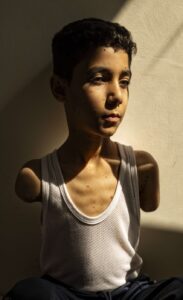

Figure 1
Samar Abu Elouf’s portrait of nine-year-old Palestinian boy Mahmoud Ajjour, indicated in Figure 1, is the World Press Photo of the Year 2025. His arms were severed during an Israeli attack on Gaza, he later found medical refuge in Doha.[12] When we look at the image it signals a quiet pain that strikes at the essence of humanity within Mahmoud’s visible bodily injury. Not only does it force us to imagine his pain when he was injured, but it also provokes us to contemplate how his dream to live as a fully able-bodied human has just ended. Perhaps the most striking aspect of this image is that it rejects the dramatic cues of action photography, which is a built-in feature of war or conflict photography. There is neither smoke nor blood, not even a battlefield; instead, we see a personification of the tragic aftermath of conflict and war, regardless of who is to blame.
The visibility of restraint in the photograph is politically meaningful, especially when considering humanitarian discourse. While suffering is often represented through spectacle – bodies in motion or crowds in chaos; starvation and long-term injury are not spectacular as they unfold through utter dependence and prolonged deprivation, which can reshape an entire life, as shown by Mahmoud in his portrait. As viewers we are forced to swallow our anger and view the image with a sustained attention that demands recognition of the child – not as a symbol of a protracted conflict but as a person living the ongoing consequences of war.
In Mahmoud’s portrait, we can apply Butler’s concept of grievability to a concrete framework. Here the child’s injured body not only functions to invoke emotions, it also poses a question to viewers throughout the world: Is this boy’s life recognised as a life that demands protection?[13] Despite substantial coverage of the suffering and massacre of Palestinians, this photograph refuses to treat Palestinian suffering as perpetual background. If anything, it evokes a feeling of responsibility to confront the intimate cost of political decisions that end in military action, which subsequently turns humanitarian access into a bargaining chip. What this portrait does to the naked eye goes far beyond displaying to it the physical cost of war; it shows the fundamental innate lapse in human judgment that allows for the calamity of war to occur when it need not, that allows for civilian casualties when their lives and limbs could have been spared.
Furthermore, when applying Azoulay’s concept of the civil contract, the ethical frames of the portrait do not stay within the bounds of a private image. Once it enters the public space as a claim, the child cannot merely be depicted but is instead positioned as a rights-bearing subject whose vulnerability and lack of protection implicates a political community beyond borders.[14] In this sense, the photograph’s power is not only emotional for the viewer but also juridical in aspiration, given it points toward obligations, such as the right to medical treatment, humanitarian access, civilian immunity without pretending that the image itself can enforce them.
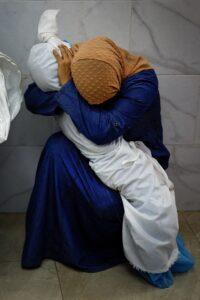

Figure 2
Mohammed Salem’s Reuters photograph of Inas Abu Maamar holding the body of her five-year-old niece is shown in Figure 2, which won World Press Photo of the Year 2024.[15] Like the 2025 portrait, the image is intimate and centred on the enclosed – almost suffocating – space of one woman’s grief rather than on the panoramic scale of destruction and mass killings. Here the photograph depicts the physical act of holding, as if the remedy of Inas’s grief is contained within the body of the child. It evokes not only an empathetic feeling among viewers but also draws attention towards Inas’s mourning as inseparable from the unmistakable finality of death. The photograph differs in one crucial way: the child’s small, shrouded body – limp and unresponsive- transforms Inas’s tight embrace into an act that is both protective and futile. In the eyes of the viewer, this is not only a photograph of loss, but one of confrontation with irreversible absence. The grief photograph forces the viewer to imagine the tragedy of thousands of other Palestinian children whose lives ended with an Israeli strike. The photograph’s power is perhaps best revealed in depicting violence as an outcome rather than an event through the quiet, irreversible absence left behind when a life is ended before it had even begun to experience the world.
The photograph is notable for its subtle yet striking visual effects. To understand the visual effects, Sontag’s analytical approach to visual arts is essential. Caution is necessary in this regard as such images can become ‘icons’ that indeed draw attention but can also be consumed as a shorthand replacement for deeper understanding.[16] Understanding the public’s appreciation for icons is equally important, as iconic images most effectively reorder public opinion and feeling. Rancière would call this sort of visual work a ‘redistribution of the sensible’ – wherein what is oft treated as dismissible or distant news is forced by the image into a space of shared affect and recognition.[17] The photograph’s power in illustrating the significant civilian loss in Gaza led to Reuters to revisit Inas’s grief story. This highlights how a single image can become a symbolic anchor while the broader violence continues.[18] Additionally, it depicts a central dilemma where photography can increase and accelerate recognition, but recognition does not guarantee protection.
New Visual Grammar of War in Lebanon: Fear from Above, Displacement Below
Lebanon’s visual story since October 2023 has been shaped by military escalation along the Israel-Lebanon frontier, as an ostensible result of Hezbollah’s involvement in the broader regional conflict following the October 7th attacks and the subsequent war in Gaza.[19] Israel’s military interventions effectively removed most of Hezbollah’s leadership while civilians absorbed the consequences; including displacement, destruction, and the collapse of any sense of stability and safety. Heightened missile and drone activity instilled fear and panic among populations in Lebanon, causing mass displacement. UN briefings and humanitarian reporting documented large-scale displacement and civilian harm as airstrikes have gradually intensified since the start of Israel’s ‘Operation Northern Arrows’ in Lebanon.[20]
To illustrate the visual fears from the sky, the photograph in Figure 3 anchoring this section is Murat Şengül’s ‘Drone Attacks in Beirut,’ which was named a Regional Winner (Singles) for the West, Central, and South Asia region by the World Press Photo 2024 contest. In its portrayal of civilians in Beirut looking toward the sky during heightened tensions and drone activity along the Israel–Lebanon front, the photograph captures a paradox innate to conflict and war in which people seeking safety outdoors meet dangerous skies while looking upward, as if the sky itself has become a source of threat.[21]
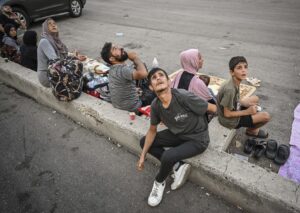

Figure 3
Note that the photograph does not strictly showcase destruction or any visible human rights violations.[22] Rather, it depicts aerial threat, specifically drone fear, as a new visual grammar of war. The level of anticipation seen in the eyes of the displaced civilians is well captured in the photograph, so much so that it puts the viewer at unrest, as if the very psychology of waiting applies naturally. The World Press Photo’s jury comment particularly highlights the photo’s depiction of fear under drones and further showcases the collapse of ordinary shelter when threat is aerial and unpredictable. Here, we see that traditional defensive measures against drones do not apply, as drones ignore the walls of our homes and the gates of our apartment complexes. One can clearly see that the civilian body becomes sensor-eyed and turns skyward, living on the edge with a tense posture, where every space is one of vulnerability. The photograph brings an intense feeling to the viewer signalling a complete lack of safety, as far as the eye can see.
This situation effectively applies Chouliaraki’s concept of spectatorship where humanitarian communication often relies on visible injury to generate pity among viewers. However, drone warfare has a specific nature that cannot be fully categorised as ‘visible injury.’ The very specific nature of drone warfare displaces suffering into the register of anxiety and a spectacle of terror in which the threat is constant but not always visible.[23] In this regard, the very premise of what can be photographed is transforming, given that human rights harm is both physical and psychological in an environment of perpetual insecurity. This state of insecurity is reflected in Lebanon’s displacement figures that has reached staggering levels, with reporting and humanitarian updates citing mass movement and widespread Israeli evacuation orders.[24]
Therefore, this photograph reveals the structural realities that expose civilians to aerial strikes while state or non-state actors avoid responsibility, resulting in civilian casualty and human rights violations.[25] Equally important, the photograph’s intention of capturing fear directly connects with Azoulay’s civic framework. It depicts the spectator as ‘called to take part,’ not necessarily by donating or sharing, but by recognising that civilian vulnerability not as an unfortunate accident, but as a consequence of political choices.[26] The photograph’s role thus goes beyond a single frame and becomes a civic pronouncement that asks: If the sky is weaponised, what does civilian protection mean? Who is accountable when safety is structurally unavailable?
Photography as Visual Testimony to Minority Persecution in Post-Assad Syria
Since December 2024, the fall of the Syrian regime under Bashar al-Assad has fuelled a wave of sectarian violence and minority persecution throughout Syria. The struggle for legitimacy in post-Assad Syria has further destabilised the lives of Syrians who are under constant threat from different armed groups affiliated with the interim government, in addition to rogue ISIS elements. At the frontline of sectarian violence and minority persecution are the Alawites, Druze, and Kurds who have been systematically targeted by both state and non-state actors in Syria. A Reuters investigation documented coordinated killings of Alawites along Syria’s coast in March 2025, carried out by units integrated into forces affiliated with the current Syrian government led by interim President of Syria Ahmed al-Sharaa and to chains of command reaching Damascus.
Although most of the evidence regarding visual material and reporting on violence against minorities take the form of video recording, some photographs, such as those used in this article, are truly visual testimonies to mass persecution and violence in post-Assad Syria. Beyond sectarian violence, there is abundant evidence of gender-based violence against minorities, specifically Kurdish women fighters from northeast Syria. Reported abuse indicates evidence of gendered humiliation where violence targets not only the female body but an entire communal identity.
Syria’s case, given the political forces at play, including non-state actors, shifts the article’s focus from photography as a moral shock to photography as a forensic claim. Looking at the art of photography is one thing and transforming that into a body of evidence that operates closer to testimony is another. Thus, as these photographs enter archives, investigations, their value becomes truly visible in pushing political mobilisation that contests denial and erasure of violence.
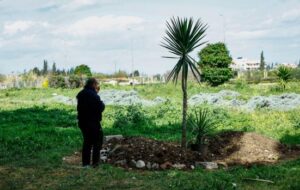

Figure 4
The Alawite massacre investigation by Reuters challenges visibility against erasure in the context of mass killings of minorities. The Reuters report transcends the usual emotional depiction of violence and delves into constructing public knowledge through survivor testimonies, video verification, documentation practices, and counting methodologies.[27] In the context of Syria, where truth is contested and violence normalised, photojournalism becomes a form of rights work, simply through the act of archiving the evidence. The photographs embedded in Reuters’s reporting, such as Figure 4 depicting an Alawite man mourning the death of his buried family members, performs a function equal to legal evidence by challenging erasure of identity.[28] The man in the photograph represents the story of many other Alawite families whose members did not fall in line for battle but were persecuted for their beliefs in a new Syria entangled in post-conflict sectarian violence.
In the context of minority suffering, Butler’s analytical frames are crucial to examining how different actors instrumentalise minority persecution to justify vengeance or deny responsibility.[29] Visual evidence here becomes politically alienable because it can be weaponised and used by multiple non-state actors who practice state ideology while working in the shadows to avoid responsibility. The challenge in this case is not legal in so much as it is ethical. This is because when photography becomes visual testimony, it avoids treating minority victims as narrative tools and instead depicts them as rights-bearing lives whose protection is non-negotiable. Here we are reminded of Sontag’s warning, especially given that images of massacres can arouse horror, and yet horror can also feed cycles of revenge.[30]
To this end, the key issue the viewer must address is not merely what happened but also how they can mobilise to protect minorities and hold perpetrators accountable, or in other cases, how they can practice restraint to avoid a new wave of escalation and violence against the perpetrators. Consequently, viewers can distinguish that photography can expose atrocity while also acting as fuel for incendiary politics. Where the art of photography is concerned, any serious human rights analysis thus holds this tension.
Communicating Violence through a Gendered Lens
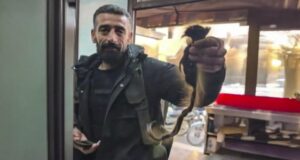

Figure 5
In this January 2026 photograph, a member of an armed group affiliated with Syrian interim government boasts while holding the severed braid of a deceased Kurdish woman who was a fighter in Raqqa.[31] This incident, which was captured on video and was heavily circulated on multiple social media platforms, triggered a wave of responses. Women posted their photos and videos depicting them in braided hair in protest of the original footage that was meant as a symbolic humiliation targeting gender, identity, and dignity. The female braid carries symbolic meaning for Kurds, with the braid representing honour, autonomy, and belonging. The regional and international backlash demonstrates the power of a single photograph in shaping public perception and mobilising human rights voices as a consequence.[32] The very act of taking and mockingly displaying the braided hair as a trophy is not only a gesture of physical victory but is also a gendered act of asserting domination. Thus violence, although not visible in the photograph, is applied through the lens of symbolic desecration that extends beyond physical death.
What makes this photograph particularly significant is that it transmits violence through new means of communication. This is especially true when the militant’s gesture toward the camera suggests intentional staging. What the viewer sees when looking at the image is visual violence, brutality through communication, and a new rendering of psychological warfare. The photograph represents a visual form of violence that can be understood as performative humiliation, where the objective is not only to defeat a female opponent but also to degrade the social and moral identity of the Kurdish community, which is known for protection of women’s rights and broader liberties in northeast Syria.
Analysing the gendered dimension of this photograph becomes crucial to understanding how specific male figures communicate violence in the Levant. For instance, the presence of female fighter units in northeast Syria disrupts traditional expectations of women in society, and specifically in conflict. This is mainly because their presence often carries political meaning tied to resistance, autonomy, and the broader social transformation of women’s place in society. Thus, targeting them in such a symbolic way represents an attack on women’s rights and effectively becomes an attempt to reassert patriarchal order by punishing that disruption regarding the traditional expectations of women in society.
In light of this understanding, the braid represents a site where political, cultural, and gendered meanings converge in a single photograph. The subsequent regional and international backlash of women braiding their hair in solidarity, including Princess Kate Middleton,[33] transforms the original symbol intended to humiliate female fighters. The global protest of braiding hair after the incident can be taken as a counter-image fuelling refusal to let gendered-humiliation stand as the last word.
This is a classic example of how symbols in conflict transform in the eyes of the viewers and are contested and reclaimed, as Azoulay’s framework explains. This is also where visual politics in the context of gender represents a picture of duality where violence produces a photograph and resistance produces a response. Additionally, Rancière’s ‘distribution of the sensible’ captures the stakes further since the original act attempts to define what Kurdish female bodies, specifically fighters, mean in the public eye, as if disposable, humiliated, conquerable. The protest reconfigures meaning by reasserting presence, transforming hair into a symbol of solidarity rather than trophy.[34] The photograph, besides generating fierce debate over women’s rights, has turned into a battlefield over interpretation.
Conclusion: Ethical Tensions and Photography
Understanding the art of photography as a tool for human rights mobilisation requires a critical approach in addressing its implicit ethical tensions, especially when it shows human suffering. It cannot be denied that photography is among the most effective tools in this modern age for shedding light on human rights abuses. Nonetheless, no human rights defence of photography can counteract the ethical challenges of showing suffering, given that survivors may be retraumatised by circulation and viewers may be exposed to consuming trauma as content. Thus, the critique Sontag sets forth in her argument holds truth here beyond the fatigue of retraumatisation. It symbolises the power of visual arts and photography as part of a broader ethical inquiry of who gets to look, and under what conditions.[35] Furthermore, this ethical tension equally points toward Azoulay’s interpretation where the viewer’s spectatorship is not innocent but is political; the photographed individual is not merely a subject but a participant in a civic relation.[36] This suggests that photographs cannot be treated as free ethical currency for the viewer’s self-image. Awareness is not a virtue; it is only the beginning of obligation.
The ethical tension thus should take a cautionary turn where photography and humanitarian communication is concerned, as it can potentially become post-humanitarian. This is especially true when circulated photographs become less about solidarity and more about managed emotion, and where engagement centres on the spectator’s experience rather than the victim’s rights.[37] In today’s social media era, sharing a photograph can be both a form of amplification and a form of detraction, especially when the act of sharing replaces sustained social and political engagement.
This is why the choice of what photograph to depict matters. The selected photographs here focus on people, consequences, and visible fear rather than graphic violence. Nonetheless, this is not censorship but an ethical choice with the objective of recognising loss and suffering without exploiting human dignity and bodies, rendering it visible and meaningful while avoiding further humiliation.
While photography cannot substitute for humanitarian access, legal accountability, or political mediation, it can perform by and large a civic function when institutions fail. As seen in the figures in the article, practicing the art of photography should follow suit its civic function in the Levant’s conflict zones by insisting that suffering is not an acceptable background condition of political transitions. Photography should be seen as an effective tool to make claims that cross borders even when law does not. Photography thus is not merely a record of violence but a struggle over who counts as human and what obligations follow from viewing.
AI Assistance Statement
The author used Claude (Anthropic) for grammar checking and QuillBot for citation formatting prior to Rowaq’s updated AI policy, with all analysis, arguments, and writing remaining entirely the author’s own.
Photo Use Acknowledgement
Images used in this article have been sourced from publicly available and open-access platforms. To the best of the author’s knowledge, these materials are either in the public domain or are used in accordance with applicable fair use and open-source guidelines. Proper attribution has been provided wherever required. The author assumes full responsibility for the selection, use, and republication of these images within this work, and confirms that their inclusion complies with relevant copyright and usage standards.
[2] Ariella Azoulay, The Civil Contract of Photography (Zone Books, 2008), https://doi.org/10.2307/j.ctv1qgnqg7.
[3] Judith Butler, Frames of War: When Is Life Grievable? (Verso, 2009).
[4] Susan Sontag, Regarding the Pain of Others (Farrar, Straus and Giroux, 2003).
[5] Sontag, Regarding the Pain of Others, 7–12.
[6] Azoulay, The Civil Contract of Photography, 11–25.
[7] Butler, Frames of War, 1–32.
[8] Jacques Rancière, The Politics of Aesthetics: The Distribution of the Sensible, trans. Gabriel Rockhill (Continuum, 2004).
[9] Lilie Chouliaraki, The Spectatorship of Suffering (SAGE Publications, 2006), https://doi.org/10.4135/9781446220658.
[10] Sky News, “Gaza is Worst Humanitarian Crisis I Have Seen in 50 Years, Top UN Official Says,” 2024, accessed 1 May 2026, https://news.sky.com/story/gaza-is-worst-humanitarian-crisis-i-have-seen-in-50-years-top-un-official-tells-sky-news-13071666.
[11] Integrated Food Security Phase Classification, “Gaza Strip: Acute Food Insecurity Classification,” accessed 28 February 2026, https://www.ipcinfo.org/ipc-country-analysis/en/?country=PSE.
[12] World Press Photo, “Mahmoud Ajjour, Aged Nine,” accessed 22 February 2026, https://www.worldpressphoto.org/collection/photo-contest/2025/Samar-Abu-Elouf/1.
[13] Butler, Frames of War, 1–32.
[14] Azoulay, The Civil Contract of Photography, 79–106.
[15] World Press Photo, “A Palestinian Woman Embraces the Body of Her Niece,” accessed 22 February 2026, https://www.worldpressphoto.org/collection/photo-contest/2024/Mohammed-Salem-POY/1.
[16] Sontag, Regarding the Pain of Others, 105–113.
[17] Rancière, The Politics of Aesthetics, 12–19.
[18] Reuters, “A Picture of her Grief Gripped the World. A Year On, Gaza Woman Haunted by Memories,” 7 October 2024, accessed 28 February 2026, https://www.reuters.com/world/middle-east/picture-her-grief-gripped-world-year-gaza-woman-haunted-by-memories-2024-10-07/.
[19] ACAPS, “Lebanon: Escalating Hostilities,” 1 October 2024, accessed 15 February 2026, https://www.acaps.org/en/countries/archives/detail/lebanon-escalation-of-hostilities-key-humanitarian-developments.
[20] United Nations Office for the Coordination of Humanitarian Affairs, “Lebanon Flash Update #35: Escalation of Hostilities in Lebanon,” 16 October 2024, accessed 21 February 2026, https://www.unocha.org/publications/report/lebanon/lebanon-flash-update-35-escalation-hostilities-lebanon-14-october-2024; Reuters, “Civilians Bear Brunt in ‘Catastrophic’ Lebanon Conflict, UN Official Says,” 3 October 2024, accessed 21 February 2026, https://www.reuters.com/world/middle-east/civilians-bear-brunt-catastrophic-lebanon-conflict-un-official-says-2024-10-03/.
[21] World Press Photo, “Drone Attacks in Beirut,” accessed 25 February 2026, https://www.worldpressphoto.org/collection/photo-contest/2025/Murat-Sengul/1.
[22] World Press Photo, “Drone Attacks in Beirut”.
[23] Chouliaraki, The Spectatorship of Suffering, 1–24.
[24] Reuters, “Lebanon’s Streets Fill with Residents Fleeing Israeli Strikes,” 18 October 2024, accessed 22 February 2026, https://www.reuters.com/pictures/lebanons-streets-fill-with-residents-fleeing-israeli-strikes-2024-10-16/.
[25] United Nations High Commissioner for Refugees, “UNHCR Lebanon Emergency – Regional Update,” 20 November 2024, accessed 22 February 2026, https://reliefweb.int/report/lebanon/unhcr-lebanon-emergency-regional-update-20-november-2024.
[26] Azoulay, The Civil Contract of Photography, 183–207.
[27] Reuters, “How Reuters Counted the Dead in the March Killings of Syrian Alawites,” 30 June 2025, accessed 2 March 2026, https://www.reuters.com/world/how-reuters-counted-dead-march-killings-syrian-alawites-2025-06-30/.
[28] Reuters, “Syrian Forces Massacred 1,500 Alawites. The Chain of Command Led to Damascus,” 30 June 2025, accessed 26 February 2026, https://www.reuters.com/investigations/syrian-forces-massacred-1500-alawites-chain-command-led-damascus-2025-06-30/.
[29] Butler, Frames of War, 59–80.
[30] Sontag, Regarding the Pain of Others, 114–122.
[31] Kurdistan24, “Kurdish Women Braid Hair in Global Protest Over Abuse of Female Kurdish Fighter in Syria,” 22 January 2026, accessed 28 February 2026, https://www.kurdistan24.net/en/story/889135/kurdish-women-braid-hair-in-global-protest-over-abuse-of-female-kurdish-fighter-in-syria.
[32] Bianca Jones, “Kurdish Women Worldwide Braid Hair in Defiant Response to Syrian Terrorist’s Atrocity,” JFeed, 22 January 2026, accessed 4 May 2026, https://www.jfeed.com/news-world/kurdish-women-braid-hair-solidarity.
[33] Natasha Walter, Instagram reel, 28 January 2026, accessed 4 May 2026, https://www.instagram.com/reel/DUDRZm2DM5e/.
[34] Rancière, The Politics of Aesthetics, 20–33.
[35] Sontag, Regarding the Pain of Others, 98–104.
[36] Azoulay, The Civil Contract of Photography, 286–312.
[37] Chouliaraki, The Spectatorship of Suffering, 229–237.
Read this post in: