
Views: Gen Z Protests in Morocco, A Passing Moment or an Emerging Social Movement?
Citation: Zaanoun, Abderrafie. 2026. “Views: Gen Z Protests in Morocco, A Passing Moment or an Emerging Social Movement?” Rowaq Arabi 31 (1): 45-56. https://doi.org/10.53833/OXSO6064.
In the September and October of 2025, Morocco witnessed a social movement unprecedented in its modern political history. Its exceptionality can be viewed in terms of the ‘bearers of demands,’ who are the youth long characterised by their apathy towards political participation; the ‘basket of demands,’ which is predominantly social in nature, and the ‘mechanisms for raising demands’ reliant upon the use of digital media in mobilisation and coordination. Youth relied especially on the Discord application, which acted a technical solution reinforcing the decentralisation of leadership and management of protest activities.
The protests gained substantial momentum in terms of the number of participants, the levels of public support, and the ceiling of the desired reforms, where demands were formulated in stages through a participatory methodology. This momentum gradually declined, however, causing the groups overseeing the movement to substitute intensive field action with limited demonstrations. At the same time, they retreated to the virtual sphere and reorganised the protests to address the responses of the government and the positions of political and civil actors.
Positions diverge regarding the potential trajectories of these protests, which were led by the youth of Generation Z or ‘Gen Z’ (born between 1997 and 2012). The’s movement rapid emergence paired with its rapid decline may indicate it to be merely a ‘transient surge’ influenced by youth movements around the world as well as short-lived sympathy for those excluded from healthcare services. On the other hand, there are indications that the youth movement constitutes a ‘reference’ event that goes beyond its circumstantial nature to lay the groundwork for a cross-generational social movement with long-term impacts on patterns of demand-driven protest, as well as on patterns of political and social realignment.
The paper aims to highlight the driving factors behind Generation Z protests in Morocco compared to previous forms of protest. It analyses the transformations in the dynamics of youth mobilisation and the responses of the authorities. The paper further seeks to anticipate scenarios for the political effectiveness of this sociodemographic group given indications of their emergence as propagators of a distinct sociopolitical movement. Gen Z is thus analysed in terms of its organisational structure, working methodologies, the ceiling of its demands, and the mechanisms for advancing and defending these demands.
Between Local and Global: Inspirations for the Gen Z Protests
The Generation Z protests in Morocco (GenZ212) emerged unexpectedly. There had been no clear indicators of an imminent wave of youth-led, demand-driven protests. Various official and unofficial reports had consistently pointed to the decline of protest momentum following the local movements witnessed in the regions of Rif (2016) and Jerada (2017), in addition to a waning ‘activist spirit’ among Moroccan youth. For a long period, a narrative prevailed linking new generations to virtual challenge games and portraying them as averse to engaging with serious public issues, especially amid the declining mobilising roles of political parties, the media, civil society, and student and labour movements. Nevertheless, reality ultimately demonstrated that this group was behind the launching of the largest protest movement in Morocco since 2011.[1]
The element of surprise does not obscure the accumulation of several underlying factors that fuelled feelings of rejection among Gen Z youth, who, according to the 2024 census, number around 9.6 million out of a total population of 36.8 million, approximately 26.3 per cent of the population.[2]. Public policies have not kept pace with this demographic shift amid worsening socioeconomic indicators. While the overall unemployment rate is around thirteen per cent, it reaches 35.8 per cent among youth aged fifteen to twenty-four. The unemployment rate among degree holders is estimated at twenty per cent[3] amid declining job opportunities and rising structural unemployment due to the mismatch between the education system and the labour market. Gen Z now accounts for more than 25.5 per cent of the total number of young people not engaged in education, training, or employment (NEET), whose total stands at 4.3 million adolescents and youth. This means that around 1.5 million young people belonging to Generation Z are experiencing ‘structural marginalisation.’[4]
Although the issue of unemployment did not take precedence in the hierarchy of demands within the Gen Z protest movement, unemployment constituted an underlying driver of the new protest dynamics, given its social repercussions. Contrastingly, healthcare occupied a prominent place in the movement’s slogans. While it does not directly affect youth as a group, it is closely tied to the conditions of their families and immediate surroundings. It represents a key arena for questioning the effectiveness of social policies. The death of eight pregnant women in a public hospital in the city of Agadir was used as a focal point to frame the protest trajectory. This tragedy amplified the narrative supporting the protests and accelerated the shift from digital mobilisation to on-the-ground action, alongside issues related to education, with emphasis on discriminatory conditions that limit equal access to educational services.
A large segment of Generation Z youth experienced the transformations of the Arab Spring and its disappointments, and were influenced by the protest waves that followed 2011. The lessons of these experiences built the general discourse of the Gen Z movement. Despite adopting some of the social slogans of the February 20 Movement calling for justice and dignity, Gen Z’s discourse remained within a ‘low-cost’ political ceiling limited to criticising the administration of programmes and the failures of government policies, without extending to the system of governance itself. This helps explain the dominance of the demand for the government’s dismissal over calls for eradicating authoritarianism and combatting corruption, which had formed the core of the February 20 Movement’s discourse. The critical reading of previous movements led to distancing from the logic of political quota-sharing in leading the protest movement, replacing traditional organisational structuring with horizontal coordination mechanisms enabled by digital media.[5]
At the national level, the idea of protest began to take shape from the start of the ‘political season,’ with the first week of September. This moment was marked by intensifying disagreement over the social features of the latest annual budget project under the current government (2021–2026), and by growing debate over the rising cost of Morocco hosting continental and global sporting events in contrast to the limited funding allocated to key social sectors. This was further compounded by growing feelings of discontent and tension due to the government’s management of social policies, as well as the unprecedented rise in basic living costs.
At the international level, some uprisings led by youth in several countries have served as models for guidance and emulation for the active segment of Generation Z youth in Morocco. The second half of 2025 witnessed the outbreak of more than ten Gen Z protests around the world, with some bringing about radical or partial political changes. This success is highly attributed to the utilisation of communication platforms such as TikTok, Instagram, and Discord to convey marginalised voices and raise demands onto the public agenda.[6] Due to its novelty and rapid dynamism, the Nepal experience had a particularly strong influence; as limited protests by Gen Z youth succeeded in bringing down the government on 9 September 2025. Some Moroccan youth were tantalised by the possibility of achieving quick and easy political reform without taking into account the complexities of Morocco’s political, economic, and social landscape.
Generation Z youth in Morocco found their preferred outlet in the gaming and instant messaging platform Discord, which provides greater security and privacy within protected servers supervised by anonymous administrators (Admins) who use only pseudonyms and avatars.[7] The movement’s account (Genz212) includes closed rooms for administrators and coordinators, as well as thematic channels for coordinating slogans and visual forms. One room is dedicated to open voice discussions and hosting experts and activists. It also features open rooms for text and voice chat for discussing and sharing personal experiences on specific topics such as health, justice, education, and the economy. Furthermore, there are dedicated windows for voting on the timing, location, and form of protests, as well as sharing data and statements and sending instant alerts about protest locations and instructions to be followed. These and other features have made the Gen Z movement’s account on the Discord resemble a ‘logistical operations room’ for coordination, mobilisation, and networking.[8]
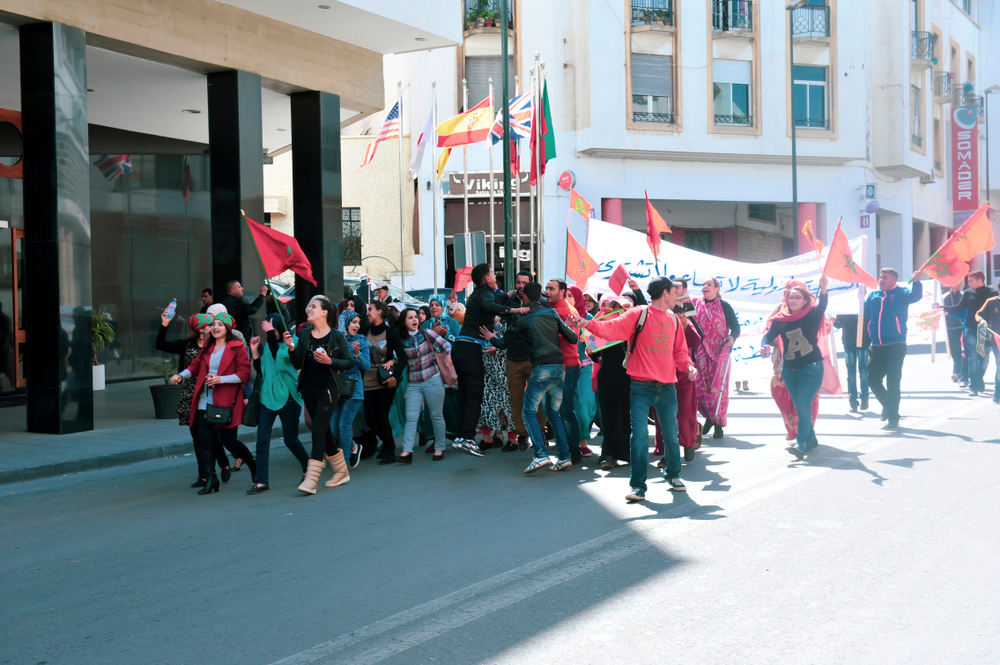
The movement’s timeline went through varying turning points, beginning with digital mobilisation on the Discord platform. The number of virtual members increased from around one thousand to more than one hundred thousand between the first and last weeks of September 2025. Field action then began on a weekly basis in six cities starting Saturday, 27 September, and almost daily during the first week of October, in parallel with the growing popular momentum. This continued until the movement resorted to a temporary suspension of protests on 7 and 8 October in light of accusations of moral responsibility for some incidents of unrest. Demonstrations also stopped on 10 October, which coincided with the royal speech marking the launching of the parliament’s autumn session. The speech carried hope for the protesters that it would respond to their demands.
Although the speech did not explicitly address the protesters’ demands, it addressed them implicitly by emphasising the acceleration of social and regional justice projects towards ensuring everyone benefits from the fruits of growth and equal opportunities in access to political, economic, and social rights. This gave the impression that any potential for political change or government reshuffle was out of the question. The movement’s activities halted for about a week, reflecting the decline in popular support for the protests.[9] After a period of regrouping and adapting, the youth movement returned on 18 October with an updated list of demands, but with smaller numbers in its political and demographic base. Popular momentum gradually eroded due to violent incidents and official promises, to the point that the movement retreated into the virtual sphere as part of a reorganisation process.[10] The discussion shifted toward reducing street protests in favour of developing more flexible forms of passive protest, including economic boycotts and organising media and advocacy campaigns through social media. Additionally, there was a focus on providing legal support for those detained in connection with the protests.
Dynamics of the Youth Movement and the Authorities’ Responses in Morocco
By virtue of its experimental nature, the Generation Z movement did not start from ready-made models and frameworks compared to previous protests. The features of its identity were formed gradually throughout the period extending from the beginning of September to the end of 2025. Demographic, political, socio-cultural, and digital variables combined to shape the movement with distinct dynamics:
- Centrality of protest geography: The geographic scope of the initial demonstrations was concentrated in major regional capitals such as Rabat, Casablanca, Agadir, Tangier, and Marrakech, before the spark spread beyond metropoles to include ten cities on 30 September.[11] Thirteen cities joined on 3 October, followed by twenty-three cities during the demonstrations of 6 October. Although the geography of protest fluctuated between ten and fourteen cities during the remainder of the October demonstrations, the number of protesters remained very limited, except in the main centres of gravity represented by the economic capital Casablanca and the administrative capital Rabat, and relatively in some regional centres such as Tangier, Oujda, and Marrakech. This indicates a retreat of the movement to its central bases. Smaller cities and rural centres were almost absent from the protest geography, despite recording the highest levels of deficits in the services that were the subject of protest, such as education, health, and employment.This paradox is linked to several factors, most importantly the ‘protest traditions’ in major working-class urban centres, and their hosting of youth actors who have accumulated experience in civic, student, and trade union activism. Waves of arrests and instances of violence that accompanied protests in the outskirts of Agadir also contributed to fuelling fears of losing control over the protest momentum. Acts of vandalism that accompanied demonstrations in ‘peaceful’ cities without prior protest histories, such as Errachidia and Ouarzazate,[12] reinforced concerns among movement participants that the authorities might adopt a pre-emptive strategy aimed at paralysing the peripheries as a first step toward suffocating the centre.
- Decentralisation of organisational structure: In addition to security concerns, the digital governance of protest action adopted innovative tools in organising and structuring that go beyond the centralised leadership and hierarchical models that characterised previous protests. No prominent figures or leadership structures emerged. Instead, reliance was placed primarily on horizontal coordination among interconnected networks within dedicated servers on Discord,[13] managed by organisers whose role was limited to facilitating communication and compiling the outcomes of discussions and voting. As communication flows on the platform evolved and the number of registered users and participants increased, the number of moderators gradually rose to nearly eighty,[14] selected on a voluntary basis and based on members’ suggestions in chat rooms, with ongoing changes made in response to criticisms regarding their neutrality, discipline, or competence. However, while this organisational decentralisation protected the movement from risks of co-optation and instrumentalization, it weakened its ability to maintain popular momentum and to channel it within a clear protest programme.
- Cumulative development of demands: The protests began with broad slogans and demands concerning health, education, and anti-corruption. However, it lacked the necessary specification in terms of details related to deficiencies and the proposed alternatives to address them. This posed a challenge to the movement’s capacity for proposals, as it sought comprehensive change without a prior political vision. A political tone dominated the first memorandum of demands addressed to the King on 2 October, calling for the initiation of judicial proceedings to hold corrupt actors accountable, the dissolution of parties involved in corruption, and the organisation of a public national session to question the government. But objections rose in chat rooms regarding the risks of politicisation and deviation from the movement’s ‘social identity.’ This led to the issuance of a new statement of demands on 7 October that prioritised reform of education, health, and justice services, as well as the provision of employment opportunities. Political demands were limited to administrative aspects, such as territorial justice in the distribution of resources, ridding administrative institutions of clientelism and involving youth in the formulation of public policies. These demands were later detailed on 10 October, in legal language and formulated on official figures, in a document bearing the remarkable title ‘A List of Demands of Moroccan Youth: For the Activation of the Constitutional Contract.’ It sought the implementation of the 2011 Constitution rather than its revision. It also signalled that the movement did not call for overthrowing the regime but rather wanted to see the regime fulfil its functions. This demand did not threaten the authority of the state but instead called for leveraging it as a framework to protect marginalised groups.[15]
- Pressure of the virtual environment: Throughout the stages of the movement, Discord served as a safe haven, shielding against attempts of infiltration, co-optation, or political instrumentalization.[16] One manifestation of this was the imposition of a form of automatic voting on various details, including slogans and the timing and dates of demonstrations. However, the rapid pace of action and reaction pushed the movement into a state of ‘organisational fatigue’ as doubts repeatedly arose regarding the selective nature of digital democracy – particularly due to hosting figures and organising activities without prior electronic consultation. The challenges of using Discord also manifested in recurring instances of banning dissenting comments that diverged from the general line. Moreover, some founding moderators were expelled for attempting to open channels of direct dialogue with public authorities. This retreat into echo chambers hindered the movement’s ability to build any alliances or connections, along with a consistent refusal of initiatives from government figures for dialogue or calls from civil and political organisations for mediation. This tendency was justified on the grounds that the movement is a leaderless social current, and that any official engagement with it should be expressed through serious responses to its stated demands. If negotiation were to take place, its natural arena, according to this view, should be within the youth’s own space: Discord.
These four dynamics, while distinguishing the movement and presenting it as a flexible and unconventional form of protest, carried the risk of imploding upon itself. The demand for immediate policy solutions to chronic social and economic problems reinforced the utopian character of the movement’s programme. Moreover, the failure to put forward actual representatives of the movement created a vacuum that was exploited by youth from some political parties, who presented themselves as speaking on behalf of Generation Z without reflecting the movement’s overall direction. Furthermore, the call to replace the government with a non-politicised management mechanism that bypasses political parties raised concerns among a broad segment of the public regarding the movement’s political identity and its commitment to democratic processes. Finally, attempts to emulate global Gen Z movements had a counterproductive effect, as they opened the door to accusations that the movement was linked to external actors and serving a non-national agenda.
Contrastingly, the authorities’ responses adapted to the movement’s dynamics by shifting from technical and security management to political management through opening space for direct dialogue with youth via public channels, with the participation of ministers and leaders of the parties forming the government. They also introduced a political-level package of solutions that contributed to isolating the movement from its social base, based on a framing that considered the expressed demands as reflecting a problem of efficiency rather than an expression of a legitimacy crisis. Accordingly, public responses were incorporated into a path of administrative reform, excluding any possibility of political change. This included the King’s call during the ministerial council held on 10 October 2025, to maximise the social impact of economic development projects while emphasising enhanced communication with citizens. It highlighted the integration of major events with social programmes, pointing to the indirect returns of infrastructure related to hosting the World Cup.[17] Additionally, the government committed – under the 2026 Finance Law – to creating new job opportunities and allocating approximately fifteen billion dollars to the health and education sectors, representing about ten per cent of the gross domestic product.[18]
The state sought to positively invest in the Generation Z movement by restructuring the political landscape through new mechanisms aimed at partially renewing elite circulation. This involved introducing adjustments to the techniques and conditions of candidacy in ways that allow competition with the traditional aging elites, who had become a burden on the representative system due to their managerial failures and involvement in public fund corruption. A focus emerged on rejuvenating representative institutions through two mechanisms: guiding political parties to grant endorsements to young candidates willing to run in elections and imposing an unprecedented exceptional measure in Morocco’s political life by allowing the formation of non-partisan electoral lists for candidates under the age of thirty-five. These candidates would receive financial support covering seventy-five per cent of their campaign expenses, thereby maximising their chances of success.[19]
Possible Scenarios: Expansion or Decline?
The temporary fading of the youth protest momentum may indicate its situational nature, as a passing moment within the broader pattern of popular reactions to unpopular government policies. This suggests that the Generation Z movement is far from constituting a social movement; its lack of a coherent protest programme and discourse has reinforced its isolation from other forms of protest expression. Although it raised slogans that enjoy broad consensus, its mechanisms of mobilisation, organisation, and communication reinforced the factional character of the protest trajectory and weakened the dynamics of broader public support around it. This is evident in the declining turnout at demonstrations: after numbering in the thousands, protesters dwindled to very few, to the point that the movement was compelled to cancel protests in some cities. In addition, there was limited response to the call for an economic boycott targeting goods produced by companies owned by the head of government, despite the symbolic significance this carries in confronting the model of overlap between capital and political power.[20]
The movement’s demographic base began to sharply decline, as its ability to engage broad segments of youth concerned with its demands weakened. This is attributable to several factors, including the pressure of security concerns and calls for actions that ran counter to the ‘societal mood,’ such as boycotting matches of the Moroccan national football team as part of efforts to shape public opinion against Morocco’s hosting of the World Cup. Based on its central slogan, ‘We do not want the World Cup, health comes first!,’ Gen Z movement calls repeatedly urged that budgets allocated for sports infrastructure and events – such as the Africa Cup of Nations in December 2025 and the 2026 World Cup – be redirected toward improving and modernising health and education facilities. This produced counterproductive effects, as it portrayed the movement as disconnected from public sentiment and youth interests, given the primacy of football in the social imagination.
This decline extended to the movement’s digital demography. The number of registered users on the Discord platform dropped from a quarter of a million in mid-October 2025 to fewer than 180,000 at the beginning of 2026.[21] The number of followers of the movement’s live discussions fell from around ten thousand to fewer than three hundred, accompanied by a major shift in the nature of comments within chat rooms, from support and mobilisation to scepticism and discouragement. This created a virtual environment that was repellent and contrary to the mobilising atmosphere that had characterised the movement’s early weeks, especially with the withdrawal and exclusion of many moderators from the platform’s servers. This decline in the digital base had direct repercussions on attempts to revive protests after the temporary suspension, with feeble participation in the demonstrations of 10 December 2025 despite the symbolic significance of the event, which marked International Human Rights Day, and the nature of the demands calling for the release of detainees.
Nevertheless, the current lull does not by any means signify the end of the Generation Z movement. It may regain its momentum more strongly than before and in unprecedented forms, as long as the drivers behind the previous mobilisations remain unaddressed. The social issues in Morocco persist, reflected in ongoing social and regional inequalities, the spread of structural unemployment among youth, and the challenges limiting effective, equitable, and sustainable access to health and education. The Moroccan political landscape has experienced the decline of traditional mediums such as a political parties, civil society, and independent media. This has led to transformations in public sphere, which carry within them the seeds of social tensions fuelled by feelings of frustration at blocked prospects, and a lack of confidence and trust in institutions and formal channels for expressing demands.[22]
The Gen Z movement may contribute to laying the groundwork for an intergenerational social movement, especially if the pledges made in response to protesters’ demands are not fulfilled, and if new social developments emerge that validate the movement’s protest narrative. Some early indications of this scenario have already surfaced in 2025, including the 3 November protest in front of the parliament, organised by those affected by the Al Haouz earthquake; the support for journalists’ protests on 28 November, which called for the dissolution of the National Press Council; and the initiative on 20 December to organise solidarity protests with flood victims in the city of Safi, which the movement framed as further evidence supporting its position.[23] Additionally, there were calls to join protests organised by ‘contract teachers’ on 21 December, as well as solidarity on 25 December with workers who are victims of exploitation and arbitrary dismissal.
The emergence of an intergenerational social movement is contingent on the movement’s social model, particularly in terms of its targeted demographics, given the exceptional diversity of identities within Generation Z. It also hinges on its organisational framework in terms of protest management mechanisms and building bridges of cooperation with claim-makers in a way that elevates demands onto the formal policymaking agenda. Limiting collective interaction to online platforms rather than engaging in discussions within public spaces reinforces the movement’s tendency toward isolation rather than embedding itself within human rights, civil, and media spheres, and hinders its transformation into a field-based social movement. To ensure sustainability, the residual effects of the Gen Z movement’s origins in the online sphere must be overcome, through the formation of objective alliances with various forms of issue-based protest movements. If the movement’s podcasts continue to downplay the role of political parties and existing channels of mediation, this could further intensify the rejection of representative institutions. Even though the movement tends to view such mediums and institutions as part of the problem rather than part of the solution, most of its demands nonetheless require engagement through government and parliamentary channels, alongside the support of political parties.
There is a third scenario in which the movement would be neither a fleeting surge nor a short-term social movement. Its impact would be structural over the medium and long terms through its contribution to the development of various forms of issue-based protests by introducing innovations in protest methodology. This would rely on the possibilities offered by digital technology for mobilisation and communication, especially in light of the evolving political uses of artificial intelligence applications,[24] and on horizontal organisational networks that provide greater flexibility in mobilisation and coordination and are more resistant to infiltration and manipulation. The movement’s short-lived legacy could become a source of inspiration for emerging cohorts of Generation Z and Generation Alpha (born between 2010 and 2024), by transforming its symbols and slogans to more effectively target youth angered by exclusion and marginalisation. This could contribute to the formation of an intergenerational movement with a socio-political identity that gradually evolved from previous shortcomings. which had partially isolated it from the political and social context.
At the strategic level, there are obscured political effects that are expected to unfold over time. The growing political awareness among unstructured youth groups is likely to shape political and policy solutions through comprehensive reforms of the frameworks governing the party and electoral environment, with the aim of enhancing their appeal to young people. The need to diversify mechanisms for involving youth in representative institutions will become more pressing, contributing to accelerating elite circulation. This transformation may even lead into the authorisation of a youth-oriented political party.
Generation Z is expected to influence public policy structuring in becoming responsive to the needs and demands of young people, alongside strengthening the virtual presence of institutional actors on youth platforms in order to reach the ‘internet-resident generation’ (iGeneration). At the same time, opposition forces are likely to seek to develop mechanisms for attracting Gen Z youth in their efforts to strengthen their social legitimacy and renew their demographic base with individuals who possess greater effectiveness and credibility.
Conclusion
The Generation Z movement in Morocco was marked by its rapid transformation, in just a few days, into an unprecedented wave of protest led by non-politicised youth groups, with mobilisation and coordination taking place from within a platform known for multiplayer video games. The momentum of the movement, however, did not last more than a month amid fluctuating international and national conditions. This decline does not imply that the Gen Z chapter should be closed. Dialogue and mobilisation activities may continue in order to draw lessons from the experience and employ them in developing protest strategies that are resistant to co-optation. This would be based on networked organisation rather than hierarchical structuring, in line with the movement’s adopted slogan: ‘Every voice is leadership, and every space is a centre.’ The upsurge of Generation Z cannot be considered, with any certainty, as merely a passing episode. On the other hand, there are no strong indications that it could act as the foundation of a new social movement characterised by distinct tools and patterns of youth protest.
In all cases, the Gen Z protest movement will have lasting consequences, especially in light of worsening conditions for youth in Morocco, including rising graduate unemployment and declining access to basic social, educational, and healthcare services. An expanding number of young people have no access to education, training, or employment.
The ‘activist legacy’ of the Gen Z movement may serve as a source of inspiration for other segments of Generation Z and the emerging Generation Alpha, given the growing influence of new social media platforms in shaping political awareness, raising social demands, and developing forms of cross-border solidarity. It is therefore possible that the dynamics of youth protest in Morocco may re-emerge if new waves of Generation Z movements arise globally.
AI Assistance Statement
The author used the ‘Gemini’ tool to verify the translation of some terms from English into Arabic.
This article is originally written in Arabic for Rowaq Arabi.
[1] Renée Boskaljon, “Morocco Accused of ‘Horrific’ Abuse of Detained Gen Z Protester,” The Guardian, 19 December 2025, accessed 22 December 2020, https://tinyurl.com/2jhctrrz.
[2] El Mostafa Rezrazi, “Generation Z and Alpha in the Face of Psychopolitical Deception: Towards an Intergenerational Rift? [Les «Générations Z et Alpha» face à la ruse psychopolitique: vers une fracture intergénérationnelle ] ” Policy Papers/Police Center for the New South, no. 13, 2 October 2025, 10, accessed 22 December 2025, https://www.policycenter.ma/publications/les-generations-z-et-alpha-face-la-ruse-psychopolitique-vers-une-fracture.
[3] High Commission for Planning, “Information Note from the High Commission for Planning on the Labour Market Situation during the Second Quarter of 2025,” 4 August 2025, 1, accessed on 8 April 2026, https://tinyurl.com/3d74mn35.
[4] Khamissa El Kachach and Zineb El Ouazzan Tihami, “Profiles and Determinants of Youth Not in Employment, Education or Training in Morocco [Profils et determinants des jeunes NEETS au Maroc],” Planning Briefs, no. 29, 25 May 2024, 1-2, accessed 8 April 2026, https://www.hcp.ma/file/240786/.
[5] Sarah Yerkes and Katheryn Selfe, “Why Morocco’s Gen Z Protests Aren’t a Second Arab Spring,” Carnegie Endowment for International Peace, 25 September 2025, accessed 14 December 2025, https://tinyurl.com/mr5dwkru.
[6] Luna CK, “Gen Z Protests Brought About Change in Nepal via the Powers — and Perils — of Social Media,” The Conversation, 11 September 2025, accessed 29 December 2025, https://bitl.to/5RKq.
[7] Jamila al-Aboudi, “The Generation Z Movement in Morocco: An Ongoing Struggle from Freedom, Dignity, and Social Justice,” Follow-up Paper (Arab Forum for Social Alternatives, 2025), 7, accessed 29 December 2025, https://tinyurl.com/mrvpkytx.
[8] Raja Gezaoui, “Generation Z in Morocco: How Did ‘Discord’ Turn into a Political Blog?”, Noon Post, 17 November 2025, accessed 11 December 2025, https://www.noonpost.com/342826.
[9] Younes Maskine, “How the Royal Speech Reshaped Youth Position on Protest, the State and Violence,” Lissan Al-Maghrib [Journal of Morocco] no. 93, 2026, 27-28.
[10] Samia Errazzouki, “Morocco at Breaking Point? Drought, Misrule, and the Rise of Gen Z 212,” Arab Center Washington DC, 20 November 2025, accessed 9 December 2025, https://tinyurl.com/3wvdtjd8.
[11] Federica Saini Fasanotti, “Gen-Z Protests Ignite across Morocco,” GIS Reports, 3 December 2025, accessed 18 December 2025, https://tinyurl.com/3ysdn8e8.
[12] Hassan Aourid, “Why Did Generation Z in Morocco Become Angry?” Al Jazeera Net, October 2025, accessed 27 January 2026, https://tinyurl.com/2yy6ezzw.
[13] Tamara Turki, “Morocco: How GenZ 212 Turned Discord into the ‘Backbone’ of its Protest Action,” Middle East Eye, 8 October 2025, accessed 27 December 2025, https://tinyurl.com/yc6z2yzf.
[14] Colin Francesco, “The GenZ212 Earthquake: Youth Shake Politics in Morocco,” Arab Reform Initiative, 16 October 2025, accessed 12 January 2026, https://tinyurl.com/3ppetde3.
[15] Nina Kozlowski, “GenZ212: The Aspirations of a Marginalised Youth [GenZ212: Les aspirations d’une jeunesse marginalisée],” Morocco Observatory – Institute for International and Strategy Relations, October 2025, 9, accessed 8 January 2026, https://tinyurl.com/yey7mwx8.
[16] Mohssine Laghzal, “Generation Z: When Moroccan Youth Invent New Forms of Mobilisation” (Gènèration Z: Quand la jeunesse moracaine de Nouvelles forms de mobilisation, Le Repoprter, no. 1236, 2 October 2025, 11.
[17] Lamia Elfehaim, “Health, Education, Transparency: The Demands of GenZ212” [Santé, éducation, transperence, les revendications de la GenZ212], Centre for Research and Studies on the Arab World (Paris), 21 October 2025, accessed 11 January 2026, https://tinyurl.com/3a5txve9.
[18] Isabel Ruck, “From Indonesia to Morocco: The Resonance of Generation Z,” (De l’Indonésie au Maroc: la resonance des générations Z), Centre for Research and Studies on the Arab World (Paris), 10 October 2025, accessed 2 January 2026, https://tinyurl.com/abdm76t8.
[19] Omar Kabbaj, “Hospitals versus Stadiums,” Africa is a Country, 23 October 2025, accessed 6 January 2026, https://africasacountry.com/2025/10/hospitals-versus-stadiums.
[20] Adel Njdi, “Generation Z Youth Brandish the Weapon of Boycott Against the Moroccan Prime Minister,” The New Arab, 7 October 2025, accessed 29 December 2025, https://tinyurl.com/2vh6xfyk.
[21] Francesco Colin, ““The GenZ212 Earthquake.”
[22] Yasmine Zarhloule, “Understanding Morocco’s GenZ Uprising,” Carnegie Endowment for International Peace, 24 October 2025, accessed 3 January 2026, https://tinyurl.com/5kjwdw6f.
[23] Mutapha Qmas, “Generation Z Pays the Price… Why Have Youth Protests Disappeared in Morocco?”, The New Arab, 21 December 2025, accessed 2 January 2026, https://tinyurl.com/yc6fwjwk.
[24] Matt Britoon, Generation AI: Why Generation Alpha and the Age of AI Will Change Everything (Hoboken: John Wiley, 2025), 43.
Read this post in: